The Golden Record
A committee of scientists had six weeks and $1,500 to compress all of humanity onto a twelve-inch disc. Then they flung it into space at 38,000 miles per hour. It's still going.
Key Facts
- Two identical records were made, one bolted to each of the **two Voyager spacecraft** launched in 1977.
- Carl Sagan was given **six weeks** to curate the entire contents of the record. His NASA budget was **$1,500**.
- The record contains **116 images**, roughly **90 minutes of music** from every continent, greetings in **55 languages**, natural Earth sounds, and the **recorded brainwaves of one newly-in-love human**.
- A **pulsar map** etched on the cover encodes the location of our Sun relative to 14 pulsars, so an alien finder could triangulate where the record came from.
- Voyager 1 **entered interstellar space in August 2012**, becoming the first human-made object to leave the solar system's heliosphere.
- In about **40,000 years**, Voyager 1 will pass within 1.6 light-years of the star *Gliese 445*. That is its first close stellar approach.
A probe, a pile of vinyl, six weeks
The Voyager program was not originally a message-to-aliens project. It was a straightforward planetary science mission: two spacecraft launched in 1977 to exploit a rare alignment of the outer planets, swinging by Jupiter and Saturn (and, eventually, Uranus and Neptune for Voyager 2) to return closeup photographs and measurements. It was a decade-long sightseeing tour of the solar system. The probes' onward trajectories were incidental — whatever velocity they accumulated from those gravitational flybys would simply sling them outward, forever, toward the nearest stars.
It was Carl Sagan who pushed NASA to take advantage of the forever part. He had done it before, on the earlier Pioneer missions, which had launched carrying a simple engraved plaque of a nude man and woman waving beside a solar system diagram. The Pioneer plaques had generated public controversy — primarily about the nudity — and NASA had decided they were probably not doing another one.
Sagan disagreed. A plaque was too meager. A thousand-year mission deserved a record. Not a poem, not a diagram: the full raucous texture of a planet — its music, its animal sounds, its languages, its pictures. He lobbied, the space agency relented, and in early 1977 Sagan assembled a committee.
The committee was tiny, by the standards of committees that are supposed to represent all of humanity. Sagan was the project director. Frank Drake, the astronomer who had formulated the Drake Equation for estimating the number of communicative civilizations, designed the technical specifications and the pulsar map. Linda Salzman Sagan (Carl's second wife at the time) and artist Jon Lomberg directed the images. Ethnomusicologists Robert Brown and Alan Lomax chose most of the music. A young journalist named Timothy Ferris served as the record's producer. And Ann Druyan, a novelist who had been a friend of Sagan's for a few years, was brought on as creative director.
They had, as noted, six weeks and $1,500 to work with. This was not enough money for their own secretarial help, let alone for rights clearances, pressing, and the gold plating. Sagan and his colleagues paid for a good portion of the record out of pocket.
What went on the disc
What do you send? That is the question the record keeps asking its listener, even if the listener is forty millennia in the future and possibly has tentacles.
The committee decided on four layers: music, natural sounds, spoken greetings, and encoded images. Each had to carry something irreducible — the kind of thing a species might recognize even without a shared language, or might at least find interesting enough to decode.
The music was the hardest. The committee wanted to span the globe and the ages, so they chose roughly 90 minutes covering about three thousand years of human composition. Bach gets three tracks, including the opening of the Brandenburg Concerto No. 2, which Sagan considered the single greatest piece of music on the record. Mozart, Beethoven, Stravinsky. A 2,500-year-old Chinese guqin piece by Guan Pinghu. Ravi Shankar's Hindustani raga 'Jaat Kahan Ho.' Louis Armstrong's 'Melancholy Blues.' Blind Willie Johnson's haunting slide-guitar dirge 'Dark Was the Night, Cold Was the Ground.' A Navajo night chant. Peruvian pan pipes. Georgian men's chorus. A Bulgarian shepherdess, Valya Balkanska, singing a traditional song that still sounds, when you listen to it today, like a signal broadcasting at a different frequency than the rest of the disc.
And Chuck Berry's 'Johnny B. Goode.' The most-debated inclusion on the whole record.
Sagan won. The record closes with three minutes and seven seconds of a man from St. Louis playing a guitar, singing about a country boy who could make it shine like a bell on a freight train. (The Beatles were considered but could not be included — not for artistic reasons, but because the committee couldn't secure the rights in time.)
The natural sounds are gentler and stranger. Twelve minutes of surf, wind, thunder, volcanoes, and rain. Crickets and frogs. Birdsong. A hyena, a chimpanzee, an elephant. Whales singing — two minutes of humpback whale vocalizations, provided by Roger Payne, slotted in underneath the greetings in a way that continues to confound marine biologists, who point out that humpback songs are a perfectly valid interstellar message in their own right.
There are also the sounds of a human inventing things: a chisel striking stone, a horse and cart, tractors, a sawing board, Morse code, the first stirrings of a rocket engine, a car on a highway. And then footsteps, laughter (Carl Sagan's), a heartbeat, and a kiss.
The greetings were recorded in 55 languages, ancient and modern, mostly by students and staff at Cornell University, where Sagan taught. They begin with Akkadian, a language last spoken in the 500s BCE, and end with Wu, a Chinese dialect spoken by tens of millions of people today. Most of the greetings are simple — 'Hello,' or 'Greetings to you, whoever you are; we have good will toward you and bring peace across space.' Some are strange. The Amoy (Hokkien) greeting wishes the listener a fine dinner. Nick Sagan, Carl's six-year-old son, contributes the English: 'Hello from the children of planet Earth.'
Finally, there are the images — 116 of them, encoded as audio signals that, if decoded properly, reassemble into raster scans. The committee picked photographs to show life: a fertilized egg dividing, a nursing mother, a grocery store, a rush-hour crowd, fishermen in Asia, Olympic sprinters, a dancer in silhouette, Bach's score for the Brandenburg Concerto, a violin paired with a page of sheet music, the Earth rising above the lunar horizon. There are diagrams for DNA, for mathematical constants, for human anatomy. There are almost no politicians and no weapons. Notably absent: any photograph of a nude human. NASA, scorched by the Pioneer plaque controversy, had asked the committee to leave nudity off. Sagan, grudgingly, agreed.
Rock music is adolescent. — There are a lot of adolescents on the planet.
— An exchange between ethnomusicologist Alan Lomax and Carl Sagan, on whether to include Chuck Berry's 'Johnny B. Goode'
The brainwaves of a woman who'd just fallen in love
The creative director of the record, Ann Druyan, had been tasked with tracking down an obscure Chinese piece for the music section. On the evening of June 1, 1977, she called Sagan's hotel to ask him a question about it. He wasn't in. She left a message. About an hour later, he called her back.
What exactly was said on that call is not fully documented — both parties have told the story, but with the slight fuzziness of people describing a conversation that changed their lives. What is clear is that somewhere in that hour on the phone, they realized, each of them independently, that they had been in love with each other for years without noticing. By the time they hung up, they had agreed to get married. Sagan was still, at that point, technically married to Linda Salzman, who was also on the Golden Record team. Druyan was engaged to Timothy Ferris, the record's producer. It was not a tidy situation.
Two days later, Druyan went to Bellevue Hospital to have her brain recorded. The plan had already been in place: the record would include, among its sounds of Earth, the electromagnetic and acoustic signals of a functioning human body. Druyan had volunteered to be the subject. She had decided, before the session, to structure her thinking — to use the meditation as a deliberate tour of Earth's history and humanity's conditions, and then to think about what it felt like to be alive on this planet right now.
What she later told interviewers was that she spent a portion of that hour thinking about Carl Sagan. About having finally realized, after four years of friendship, what he was to her. About the almost-disorienting joy of that discovery. About what it felt like to be a person in love. That portion of her brainwave activity — compressed into something like a minute of high-pitched static, with a heartbeat underneath — is on the Golden Record. Two of them, actually. There is a copy on Voyager 1 and a copy on Voyager 2.
The records will still be physically legible, according to most estimates of the pitting in their grooves, for somewhere between a hundred million and a billion years. The cosmic ray erosion rate is very low, out past the heliopause. Carl Sagan and Ann Druyan were married from 1981 until his death in 1996. She, at the time of writing, is still alive. The recording of her in love, on June 3, 1977, will outlast her by a factor of ten million.
The map on the cover
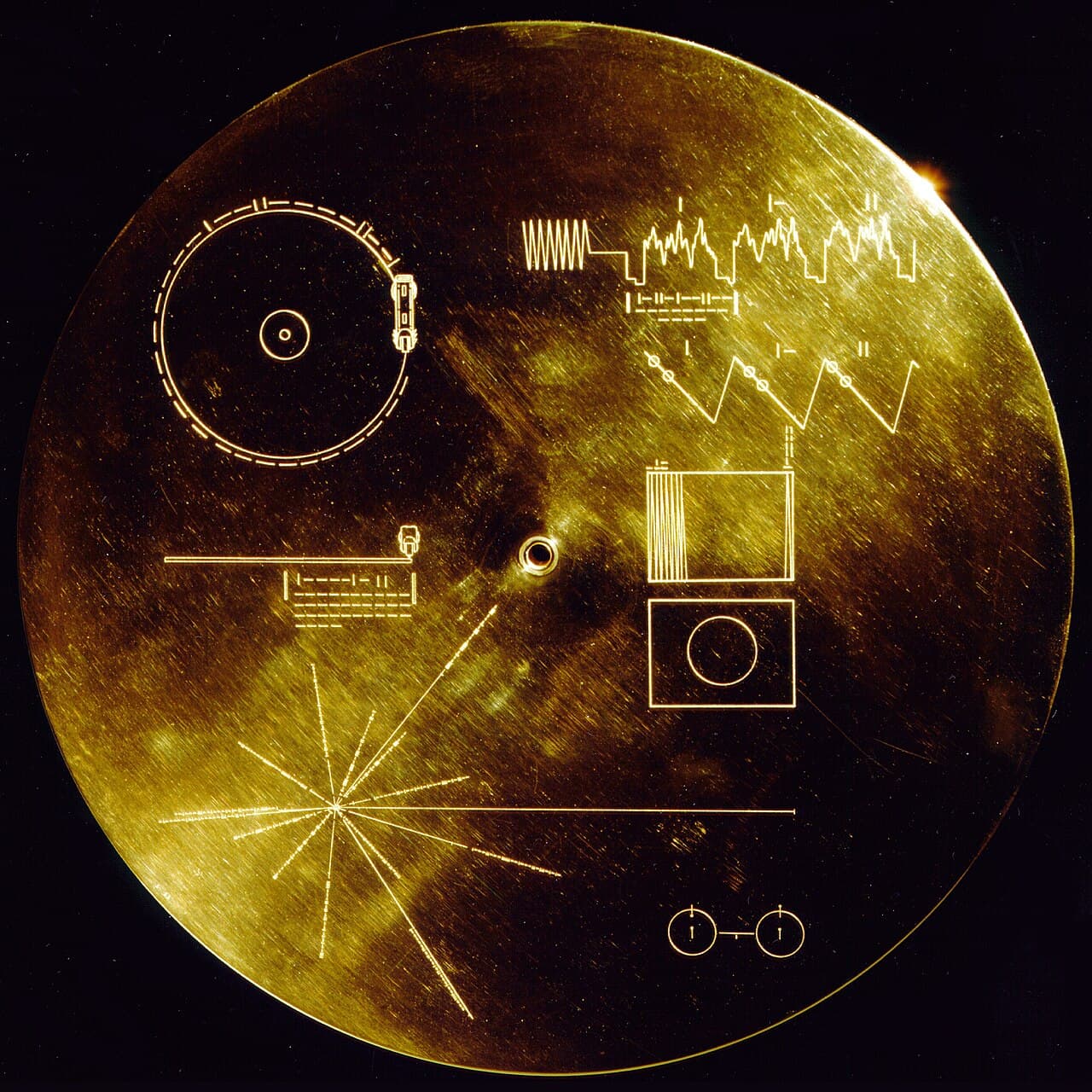
An extraterrestrial civilization that found a Voyager probe would be confronted first not with music, but with an engraving. The record is stored in an aluminum cover etched with a series of diagrams meant to explain what the disc is, how to play it, and where it came from.
The 'how to play it' part is reasonably straightforward, by the cosmic standards of this kind of problem: diagrams show the correct rotational speed (derived from a reference to the hyperfine transition of hydrogen, the most abundant element in the universe and therefore something any technological species will understand) and the correct needle position. A diagram next to the grooves shows how to decode one of the images.
The 'where it came from' part is the pulsar map. Frank Drake, its designer, had also made the pulsar map on the Pioneer plaques, so by 1977 he had already worked out the concept. The map is a starburst of fourteen lines radiating from a central point. Each line ends in a binary notation that encodes the pulsation period of a specific pulsar — a rapidly spinning neutron star that flashes with extraordinary regularity, essentially a cosmic lighthouse with a unique heartbeat.
Because pulsars slow down at known rates, a sufficiently advanced finder could work out not just which pulsars the map is pointing to, but also when the map was made, by measuring the current pulsation periods of those pulsars and back-calculating. The length of each line is proportional to the pulsar's distance from the Sun. The central dot, where all the lines converge, is us.
It is, in other words, a map with a timestamp built in. Anyone who finds it in a hundred million years will be able to calculate both where Earth is and how long ago humans built the record. It is the deepest-field business card ever made.
Where it is now
Voyager 1 launched on September 5, 1977; Voyager 2 had gone first, on August 20. (The numbering reflects their arrival order at Jupiter, not their launch order.) They flew past Jupiter and Saturn. Voyager 2 went on to Uranus and Neptune. Both probes kept accelerating.
On August 25, 2012, Voyager 1 crossed the heliopause — the boundary where the solar wind finally gives way to the interstellar medium — and became the first human-built object to leave the solar system in that sense. Voyager 2 followed, by a different route, in November 2018. They are now moving through the thin, cold, charged-particle soup that pervades interstellar space. They send back plasma-density data every few months. Each probe is powered by a plutonium-238 radioisotope thermoelectric generator whose output declines, year by year, at a predictable rate. NASA shuts off one instrument every few years to stretch the remaining watts. Sometime in the late 2020s or early 2030s, the lights will go out.
But the probes themselves will keep going. They are no longer accelerating and no longer decelerating; they are coasting, forever, at roughly 38,000 miles per hour.
Voyager 1's trajectory, traced out over the coming tens of thousands of years, wanders through a starless region of the Oort cloud, slides out into the disc of the Milky Way, and, about 40,000 years from now, passes within 1.6 light-years of Gliese 445 — a small red dwarf star currently in the constellation Camelopardalis. That is closer than any star is currently to our own sun. It is not, in any meaningful sense, a rendezvous: Voyager 1 will miss Gliese 445 by nine trillion miles, and will then keep going. But it is the first time, over the probable lifetime of the human species, that our farthest-flung message will come within shouting distance of another star.
Voyager 2 is bound, on a similar timescale, for a flyby of a small star called Ross 248. There are no known planets around either Gliese 445 or Ross 248. No one expects either record to actually be found. The point of the record was never really that it would be found.
A species looking at itself
A recurring criticism of the Golden Record is that it is hopelessly naive — a Carter-era feel-good project, heavy on whales and Bach and light on, say, the Holocaust, the Khmer Rouge, the hole in the ozone layer, or any of the other things humanity had proven itself quite capable of doing by 1977. The committee had considered darker material and decided against most of it. Druyan later said they had gone back and forth on whether to include something about war and had ultimately landed on an approximation: thunder, volcanoes, a baby crying. There is no image of a gun on the record. There are, however, photographs of Stars Wars-era highway traffic, a grocery checkout line, and a page of a Sears catalog.
But this is, to be fair, a record made in six weeks on a budget of $1,500 by a handful of scientists and writers doing it on nights and weekends. It is a gift. It is closer in spirit to a wedding toast than to a history textbook. You don't, at a wedding, recite the worst things that have ever happened to the bride.
What the Golden Record is, in the end, is an artifact of curation. Every choice on it is an argument — about what music mattered, about which languages deserved to be the first words we sent to another civilization, about whether Chuck Berry belonged next to Bach (he did), about whether nudity was too much for NASA administrators (it was), about whether to include the sound of a kiss (they did) and whether to include the sound of a newly-in-love brain (they did). The record is less a message than a mirror — a portrait of how a specific group of people, in a specific city, in a specific sweltering summer, decided to summarize everyone they had ever known.
Forty-nine years on, the bottle is still moving. It is past the heliopause. Its power is running down. Its audio — Bach, Chuck Berry, the whalesong, Nick Sagan's six-year-old 'hello,' Ann Druyan's brain — is etched into a gold-plated copper disc that no one will ever hear. The record is not a message. It is a kind of prayer, made of music. And we sent it.
The launching of this 'bottle' into the cosmic 'ocean' says something very hopeful about life on this planet.
— Carl Sagan, 1977