The Lake That Exhaled Death
On a warm August night in 1986, a crater lake in Cameroon silently breathed out a cloud of gas that killed 1,746 people before dawn. The phenomenon was so rare that scientists had to invent a name for it.
Key Facts
- On 21 August 1986, Lake Nyos released an estimated **100,000–300,000 tons of CO₂** in a matter of minutes.
- The gas cloud initially rose at nearly **100 km/h (62 mph)**, then flowed downhill through valleys for about **23 km (14 mi)**.
- Because CO₂ is **1.5 times denser than air**, the cloud hugged the ground and pushed the breathable atmosphere aside as it moved.
- **1,746 people** and thousands of animals died, most within about twenty minutes of the cloud's arrival.
- Only **three lakes on Earth** are known to be capable of limnic eruptions: Monoun and Nyos in Cameroon, and Kivu on the Rwanda–DRC border.
- Engineered degassing pipes installed at Nyos in 2001 now vent the lake's deep CO₂ continuously — the process has become **self-sustaining** as of 2019.
The night the valley stopped breathing
The area around Lake Nyos is not Hollywood's idea of a killer volcano. It is quiet, beautiful country — grassy hills, scattered maize plots, herds of humpless zebu cattle. The lake itself sits inside the collapsed crater of a young volcano on the Cameroon Volcanic Line, a long scar of tectonic activity that stretches from the Atlantic into the heart of Africa. The volcano has not erupted in centuries. The water on top is perfectly drinkable. Children swim in it. For generations the lake had been a neighbour, not a threat.
Witnesses later told investigators that between about 9 and 10 p.m. on 21 August, people near the lake heard a deep rumbling, then a sound variously described as a gunshot, a cannon, or a pot boiling over. A column of white mist shot up from the water — some survivors said it reached 80 metres into the night sky — and a large wave slopped over the southern lip of the lake, stripping vegetation from the shoreline.
Then a fog began to roll down the valley.
It did not behave like any fog the villagers had seen. It hugged the ground. It carried with it what several survivors described as a warm, sulfurous smell, like rotten eggs mixed with gunpowder. Where it passed, cookfires guttered. Oil lamps went out. A faint pressure built in people's chests. And then, within a minute or two at most, anyone inside the cloud simply fell where they were standing, or sleeping, or sitting by the hearth.
The cloud — about 50 metres thick, moving at 20 to 50 kilometres per hour — travelled first down the valley of the Cha River, then spread into the valleys that hold the villages of Nyos, Kam, Cha, and Subum. In each one it behaved like an invisible flood: pooling in low ground, slipping under doors, filling huts from the floor up. Most victims probably never understood what was happening to them. They blacked out within seconds of the oxygen being displaced, and died in coma without waking.
A few people, by simple geometry, survived. Some were on upper floors where the cloud was thinner by the time it reached them. Some were up the hillside, above the top of the moving layer of CO₂. A man on a motorbike, racing home through the fog, rode straight through the cloud at enough speed to come out the other side still breathing. He would spend the next several days burying neighbours.
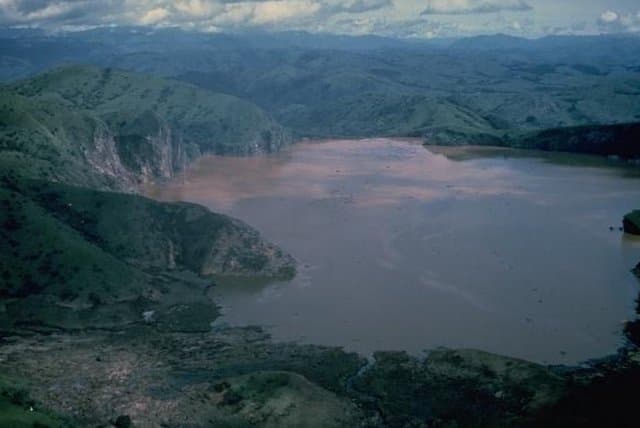
By the time outside help arrived — Cameroonian soldiers in gas masks, then a crash team of French, American, and Japanese scientists — the gas had long since dispersed. What remained was a lake that had turned a deep rust-red, a surface littered with dead fish and uprooted vegetation, and a landscape of mass graves.
I wanted to speak, my breath would not come out … My daughter was already dead … I went into my daughter's bed, thinking that she was still sleeping … I managed to go over to my neighbours' houses. They were all dead … As I rode through Nyos I didn't see any sign of any living thing.
— Unnamed survivor, translated from interviews compiled in the scientific literature
A phenomenon with no name
When the first geologists reached the region, they assumed they were looking at the aftermath of a small volcanic eruption. That was the obvious hypothesis: volcanoes release CO₂, and this was a volcano. But when they examined the crater, they found no fresh ash, no lava, no sign of a thermal event. The water at the lake's surface was only slightly warmer than normal. The trees and grasses around the shore, apart from the splashes on the southern rim, were undisturbed. Whatever had happened, it had happened to the water, not through it.
The real clue was that Lake Nyos was not the first. Two years earlier, on 15 August 1984, a smaller crater lake called Lake Monoun, about 100 km to the south, had killed 37 people in an almost identical pattern: a nighttime mist, livestock and villagers dying on the road, rust-red water in the morning. At the time, Cameroonian authorities had suspected terrorism or chemical weapons. Foreign geochemists who investigated — notably William Evans and George Kling of the U.S. Geological Survey, and a French team led by volcanologist Haroun Tazieff — concluded, tentatively, that the lake itself had released the gas. It had been hard to prove, hard to publicise, and impossible to imagine it could happen at scale.
Then it happened at scale.
How water learns to kill
To understand what the lake did, it helps to remember a scene from middle-school chemistry: the moment you crack a warm can of soda and it foams all over your hand. Carbon dioxide dissolves readily in water when it is cold and under pressure. Release the pressure — pop the can — and the dissolved gas boils out as bubbles. This is Henry's Law, and most of the time we encounter it in something delicious. Lake Nyos was a 700-foot-deep can of soda that had been very, very slowly pressurised, for what may have been centuries.
Three unusual conditions had to line up for this to happen.
First, the geology. Lake Nyos sits in a maar, a bowl-shaped crater blasted into the earth by an old steam explosion when magma met groundwater. Beneath the lake, magma is still cooling and giving off CO₂ — volcanic gas that seeps up through cracks in the crater floor and dissolves into the coldest, deepest water. On the ocean scale, this seep is small. On the scale of a small lake, over hundreds of years, it is enormous.
Second, the depth. Lake Nyos is about 210 metres deep. At that depth the water pressure is roughly twenty atmospheres — twenty times the pressure pushing down on the surface. Water at that pressure can dissolve truly staggering amounts of CO₂, far more than would ever stay in solution at the surface. Measurements taken after the disaster found that a single litre of bottom water held up to fifteen litres of gas in solution, waiting.
Third, and most important, the water never mixed. Many lakes in temperate climates 'turn over' once or twice a year, when seasonal temperature changes cause surface water to cool, grow denser, and sink — stirring the whole body of water and venting dissolved gases harmlessly. In the African tropics, temperatures don't swing enough to drive that kind of overturn. Lake Nyos is permanently stratified: a warm, oxygenated layer on top; a cold, heavy, gas-soaked layer below; and a sharp boundary between them that almost never broke.
For as long as that boundary held, the lake was a loaded crossbow with a safety catch. What tripped the trigger on 21 August 1986 is still debated. A landslide off the steep slope above the lake is the leading suspect — a sudden slug of material crashing into deep water and displacing a plume of gas-rich water upward. Other candidates include a minor earthquake, a heavy rainstorm that cooled the surface enough to start partial overturn, or a small underwater volcanic event. The mechanism doesn't really matter. Once a pocket of deep water lost enough pressure, the dissolved CO₂ began to bubble out. The bubbles lowered the density of the water around them, which caused more water to rise, which lowered the pressure further, which produced more bubbles. Within minutes, the entire bottom layer of the lake was venting itself through the surface like champagne shaken and uncorked all at once.
A conservative estimate: over the course of roughly twenty minutes, Lake Nyos released more CO₂ than the city of New York exhales in a week.
The gas came out at nearly the speed of sound from the bottom of the lake. By the time it reached the surface, it was a shockwave of bubbles.
— Paraphrased from a USGS briefing on the physics of limnic eruption
A detective story in French, Japanese, and Cameroonian
In the months after the disaster, an international scientific team converged on the lake. Cameroon asked for help, and — unusually for the era — got it from every direction at once. Americans brought sonar and gas-sensing probes. The French brought submersibles and deep-water chemistry. A Japanese team brought precision pressure instruments. Cameroonian scientists, most notably Joseph Victor Hell of the Institute of Mining and Geological Research, coordinated the whole effort from the ground.
What they found was unnerving. The lake's deep waters were already recharging with CO₂, just as they had before the 1986 event. Measurements through the 1990s showed the bottom layer heading back toward saturation. Without some kind of intervention, another eruption was not only possible — it was likely, probably on a timescale of decades rather than centuries.
The same was true at Monoun. And much more alarmingly, the same appeared to be true, on a scale a thousand times larger, at Lake Kivu, which sits on the border of Rwanda and the Democratic Republic of the Congo and is ringed by a population of more than two million people. Kivu is not just storing CO₂; it is also storing enormous quantities of methane, produced by bacteria feeding on the dissolved carbon. A full limnic eruption at Kivu — depending on which model you believe — could be anywhere from a regional tragedy to one of the worst natural disasters in human history.
Stopping any of this from happening required an unsparkling piece of plumbing, not a scientific breakthrough. The question was how to let a lake the size of Nyos burp, safely, over a span of years, without letting it detonate.
The engineering that saved a lake
Credit for the idea, and most of the execution, goes to a French physicist named Michel Halbwachs, working with colleagues from the University of Savoie. Halbwachs had spent much of his career fiddling with a gas-extraction rig on Lake Kivu that the Rwandan government had been running, on and off, since the 1960s. That rig used dissolved methane to generate electricity. The underlying principle — tap the deep, gas-rich water, let the gas expand, capture the energy — was well known. What Halbwachs proposed for Nyos was essentially the same trick, inverted: don't use the gas, just let it out. Slowly. For decades.
The apparatus is elegantly simple. A high-density polyethylene pipe, about 140 mm in diameter, is lowered from a raft on the lake's surface down into the gas-saturated bottom layer. A small pump lifts a column of water up the pipe. As the water rises and the pressure drops, dissolved CO₂ begins to bubble out. Bubbles make the water lighter than the surrounding water, so the column rises on its own. Once the flow is established, the pump can be switched off entirely. The pipe becomes a self-sustaining fountain.
A fountain, in this case, was no metaphor. The first full-scale degassing pipe at Nyos, switched on in January 2001, spouted a jet of gas and water roughly 150 feet (45 m) high above the lake surface — a permanent, roaring white plume of escaping carbon dioxide. Two more pipes were added in 2011 to accelerate the process. A similar installation went in at Monoun in 2003.
The pipes worked. By the mid-2010s, measurements of the deep water at Nyos showed CO₂ concentrations dropping steadily. In 2019, a team led by Halbwachs and his collaborator Bruno Villemant published a paper announcing that the lake had reached a new, safer equilibrium: the rate of natural CO₂ recharge from the volcanic rocks below now matches what a single pipe can remove. The pipes, in other words, can be left running forever, no power required, and Nyos will never again hold enough gas to erupt. One of the deadliest natural phenomena of the twentieth century has been, quietly, plumbed out of existence.
Monoun, smaller and simpler, is likewise safe. Lake Kivu, a thousand times harder, remains an open problem. A Rwandan company called KivuWatt has been extracting methane since 2015 and using it to generate grid electricity — about 26 megawatts as of the mid-2020s, roughly a quarter of Rwanda's peak demand. The power is real; the safety benefit is modest. A full solution at Kivu, if one is ever possible, is probably still decades away.
What happened to the survivors
Of the perhaps 5,000 people who were overtaken by the cloud and lived, survivors reported waking after comas that ranged from six to thirty-six hours. Many had what doctors later described as chemical burns on exposed skin, particularly on the face and chest — the signature of prolonged contact with acidic gas. Some were permanently partially paralysed. A handful lost the use of limbs. A peculiar and still-unexplained symptom was that several survivors, on regaining consciousness, had developed pressure sores on parts of their bodies that had been lying against the ground, as though they had been comatose for weeks rather than hours. Whatever the cloud did to the body's circulation, it was not entirely a matter of simple suffocation.
The Cameroonian government evacuated roughly 4,000 surviving residents from the most affected villages and, for a time, prohibited them from returning. The displaced were resettled in camps and in the town of Wum, about 30 kilometres away. Many stayed for years. When the degassing pipes were declared operational in the early 2000s, families began returning to farm the valleys around Nyos and Cha. Today, the old villages have been partly resettled — not by the original inhabitants, most of whom never came back, but by their children and grandchildren, and by farmers from other parts of Cameroon drawn by unusually rich volcanic soil.
The long aftermath has been complicated by politics. The region around Nyos falls inside Cameroon's Northwest Province, which has been the centre of the Anglophone separatist conflict that erupted in 2016. Journalists and aid workers who visited in the 2020s found communities of Nyos survivors who had been displaced a second time by fighting and who described the 1986 disaster as the first of two catastrophes that had shaped their lives. Several survivors interviewed by the Voice of America and by the German-funded outlet FairPlanet said that the medical care promised by the government after the eruption had never fully materialised, and that the international scientific attention to the lake had translated only patchily into support for the people who lived beside it.
Why it matters beyond the valley
It would be easy to end the story with the pipes at Nyos, as if the science were closed. It is not. The Lake Nyos disaster forced a small community of researchers to rethink what kinds of natural hazards are possible and how quickly they can appear. Until August 1986, no geology textbook included a chapter on gas-driven lake eruptions, because, as far as Western science knew, they did not happen. Two years earlier, a similar event at Lake Monoun had killed 37 people, and the cause had been disputed for months. When Nyos erupted, it revealed a class of danger — slow accumulation of a hazard, invisible until released — that had been sitting in plain sight for a long time.
That pattern, it turned out, has cousins elsewhere. The buildup of permafrost methane in the Arctic, which can release in sudden 'craters' when warming loosens the cap, is arguably a relative. Certain oil and gas reservoirs, if drilled or warmed carelessly, can exsolve gas at catastrophic rates — a mechanism implicated in several historical pipeline and mining disasters. Even the ocean is in the conversation, at least theoretically: a few researchers have argued that deep pockets of CO₂ in anoxic basins could, on long geological timescales, behave a bit like a very slow Lake Nyos.
None of these is currently dangerous to any human population. The point is that Nyos expanded our imagination. Disasters do not always announce themselves with earthquakes or fireballs. Sometimes they wait, quietly, in 15 litres of invisible gas dissolved in a litre of very cold water, a few hundred metres down.
Kwanga, one of the survivors in the village of Nyos, was quoted in a Cameroonian radio interview years after the event. Asked what he remembered most clearly, he did not mention the bodies or the coma or the silence. He mentioned the sound of the lake.
Lake Nyos is still there, looking ordinary. Its surface is back to a calm dark blue. Children swim in it again. On sunny days, you can see the white plumes of the three degassing pipes from a kilometre away — modest white feathers over a 700-foot column of water that has been persuaded, at last, to exhale slowly.
We always thought the lake was alive. Our grandparents said it was. We laughed at them. Then the lake took its breath, and we believed.
— Kwanga, survivor, Nyos village (paraphrased from interview)