The Grandmothers Who Lit the World
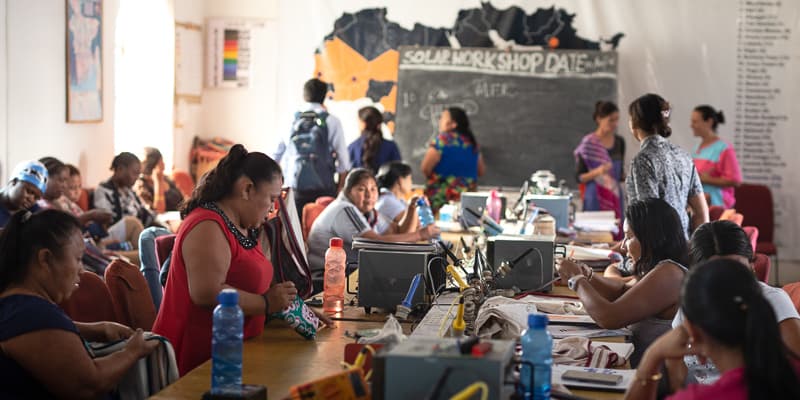
In a village in Rajasthan, something quietly extraordinary happens every six months. Women in their forties and fifties — many of whom cannot read or write — arrive from the remotest corners of Africa and Asia. Six months later, they go home as solar engineers. This is the story of Barefoot College.
Key Facts
- Barefoot College's Solar Mama programme has trained **3,500 women from 93 countries** since 1997 — most of them semi-literate or entirely illiterate grandmothers from remote, off-grid villages.
- The training curriculum uses **no written words**. Everything is taught through colour-coded wiring diagrams and hands-on practice — proving that literacy and intelligence are not the same thing.
- By 2025, Solar Mamas had brought electricity to more than **2.5 million people** who previously had none, replacing kerosene lamps that were both toxic and expensive.
- Women are specifically selected to be **35–50 years old** — older than most programmes would prefer. Barefoot College's logic: younger women might leave to marry; grandmothers stay and serve their communities for decades.
- When the first 10 women from **Afghanistan** returned home in 2005, they solar-electrified five villages. Within years, there were over **100 solar-electrified villages** in Afghanistan — all seeded by those ten women.
- The documentary *Rafea: Solar Mama* (2012) followed a Bedouin woman from one of Jordan's poorest desert villages. After training, Rafea and her aunt installed **80 solar panels in a single week**.
The College Where No Degree Is Required
In 1966, a 22-year-old Indian man named Sanjit 'Bunker' Roy volunteered to spend a summer working with famine-affected communities in Bihar, one of India's poorest states. He had grown up in a privileged urban family, educated at the finest schools, and was on a trajectory toward a conventional elite career. The summer in Bihar ended that trajectory permanently.
What Roy saw in Bihar was not helplessness. It was knowledge — extraordinary, intricate, practical knowledge about agriculture, water, weather, local ecology — that the people he met had accumulated over generations and that no university had ever thought to measure or credit. The famine was real and devastating. But the assumption that the rural poor needed educated outsiders to fix their lives struck Roy as exactly backwards.
In 1972, Roy founded the Social Work and Research Centre in Tilonia, a small village in the Rajasthan desert. The institution would later become known simply as Barefoot College. Its founding principle was provocative: formal credentials are not the same as competence, and illiteracy is not the same as ignorance. The college would train the 'barefoot' — those without degrees, without professional certificates, without the markers that conventional society uses to sort the capable from the incapable.
Over the next two decades, Barefoot College trained barefoot doctors, barefoot architects, barefoot accountants, and barefoot teachers. It installed hand pumps, managed community radio stations, and built schools designed by the villagers who would use them. But the programme that would eventually circle the globe and change the lives of millions began almost accidentally, in 1997, when the college turned its attention to a simple and devastating problem: darkness.
Two-thirds of the world's population without electricity lived in villages exactly like the ones Barefoot College served — remote, rural, entirely off the grid, with no prospect of a power line arriving in any of their lifetimes. The standard solution was a diesel generator or a kerosene lamp: expensive, polluting, and requiring constant resupply of fuel that had to be transported from distant towns. Solar panels existed. The technology was ready. What was missing was the human infrastructure to install and maintain them in places that the formal economy had never reached.
The Education That Needed No Words
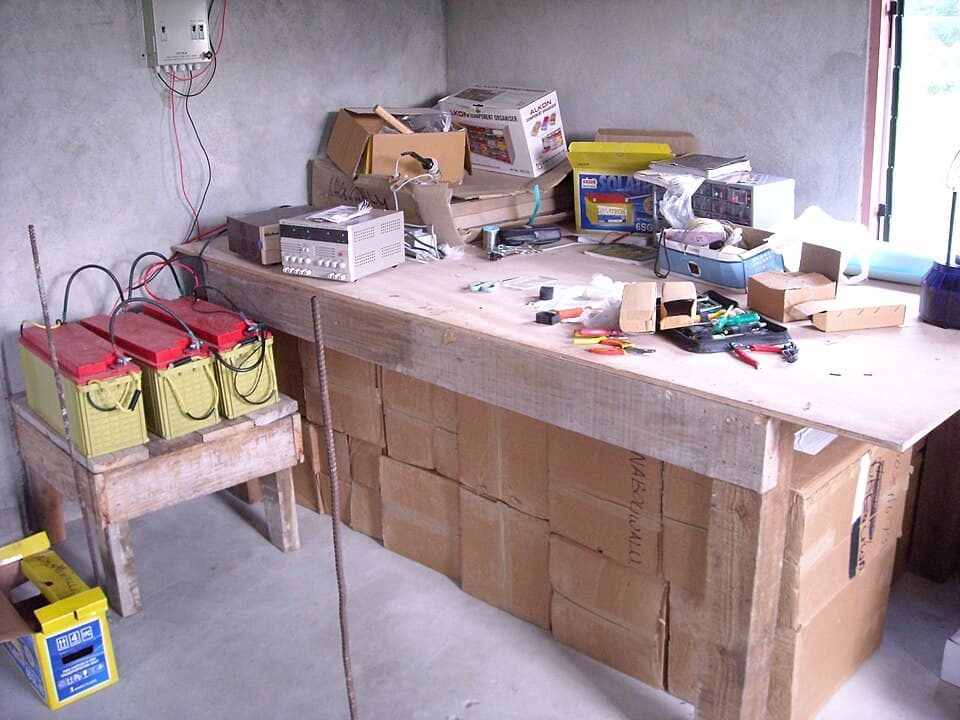
The Solar Mama programme began with a seemingly impossible design constraint: the trainees would be women aged 35 to 50, from remote villages in the developing world, most of whom could not read or write in any language. The training would last six months. At the end of those six months, they would be expected to return home and solar-electrify their entire village.
The age requirement was deliberate and counterintuitive. Every development organization that Barefoot College approached about funding the programme initially balked at it. Why not train younger women? Younger people learn faster, they said. Roy's answer was simple: younger women in rural communities are likely to get married and move away. A 45-year-old grandmother has already established her life in her village. She has social authority. She has grandchildren she will never leave. She will still be there in 20 years, maintaining the solar systems she installed.
The literacy constraint forced a pedagogical innovation that turned out to be the programme's most brilliant element. Barefoot College's instructors — themselves often from rural backgrounds — developed a curriculum built entirely around colour. The solar circuit boards, the wiring diagrams, the component layouts: all of it was colour-coded in a consistent system that could be memorized without reading a single label. Red wire to red terminal. Blue to blue. The arrangement of components was taught through repetition, through hands-on practice, through the kind of procedural memory that humans develop long before written language existed.
Women who arrived at the Tilonia campus unable to read arrived to find that their intelligence was not the obstacle anyone had implied. Within weeks, they were soldering circuits. Within months, they understood enough about photovoltaic systems to diagnose faults, replace components, and train others. The six-month residential course covered fabrication of solar lanterns and charge controllers, installation of home lighting systems, basic electrical theory, fault diagnosis, and preventive maintenance. None of it required literacy. All of it required intelligence, patience, and the kind of careful hand-work that women who had spent decades sewing, cooking, and farming already possessed in abundance.
The programme also included something that no engineering school in the world teaches: how to go home. Because returning to a village as the only person who understands solar electricity — after six months away, having left children and grandchildren behind, having crossed international borders some women had never crossed before — requires a kind of courage that no technical curriculum can fully prepare you for.
Rafea's Desert
Rafea Anad lived with her four daughters in one of Jordan's poorest villages, deep in the desert near the Iraqi border. Her husband was largely absent. The village had no electricity. The family survived on about a dollar a day.
In 2011, Rafea was selected — over fierce initial objection from her husband and extended family — to travel to India for Barefoot College's solar training. She had never left Jordan. She spoke no Hindi. She could not read. The journey itself was a kind of rupture: a Bedouin woman from a conservative rural community, boarding a plane alone, flying to a foreign country, to learn something that no one in her social world believed she was capable of learning.
The 2012 documentary *Rafea: Solar Mama*, directed by Mona Eldaief and Jehane Noujaim, followed her through the experience. It became one of the most widely watched documentaries about women and development ever made — not because it was a story of triumph over adversity in the familiar cinematic sense, but because it was honest about how genuinely hard the experience was. Rafea struggled. She missed her daughters. The training was demanding. Her family's skepticism followed her across the distance.
She graduated. She came home. And she and her aunt proceeded to install 80 solar panels in one week.
That number — 80 panels, one week, two women, no prior formal education — became something of a shorthand for the programme's argument. Not as a boast, but as a data point. The question 'what can uneducated women accomplish?' had an answer, and it was: this.
Rafea's story is exceptional in its specificity — her name, her country, her documentary — but it is not exceptional in its arc. Thousands of women have made roughly the same journey. Most of them have no documentary. Most of them came home to the same mixture of skepticism, awe, and eventually reliance that Rafea encountered. All of them lit something up.
Afghanistan's First Solar Women
In 2005, ten women from Afghanistan completed Barefoot College's solar training. The context was extraordinary: Afghanistan was in the middle of a war. Large areas of the country had no functional electricity infrastructure whatsoever. International development organizations were present in large numbers, spending enormous sums, with mixed results.
The ten women — mostly from rural villages in regions far from Kabul — returned home and went to work. They solar-electrified five villages, wiring 150 houses. Then they trained 27 more women, who trained others. Within years, more than 100 villages in Afghanistan had been solar-electrified — not by international contractors, not by government programs, not by NGOs with large budgets and foreign staff, but by networks of women who had started with one class of ten and multiplied.
The model worked because it was rooted. A foreign contractor finishes a project and leaves. A grandmother who solar-electrified her own house and her neighbor's house does not leave. She is there when the system develops a fault. She is there when a new family moves in and needs a connection. She is there to train the next woman who wants to learn. The maintenance problem — which defeats so many development infrastructure projects that work perfectly at installation and then fall into disrepair — was solved not by technology but by social permanence.
The Afghanistan example also illuminated something about the programme's design that was easy to overlook. Barefoot College did not send engineers to Afghanistan. It sent Afghans back. The knowledge was imported and then became local. The dependency — on foreign expertise, on spare parts that only foreigners knew how to source, on training that only happened in faraway places — was deliberately broken. That was the point.
The Transformation That Goes Both Ways
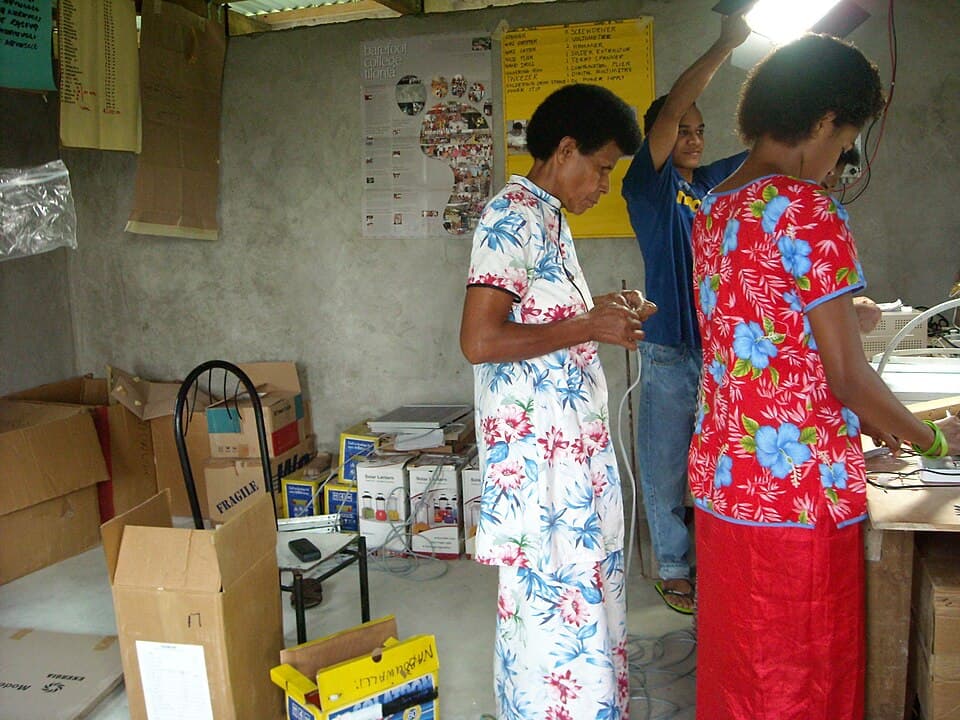
When Barefoot College describes what happens when a Solar Mama returns to her village, it usually focuses on the electricity — and the electricity is genuinely transformative. Children can study after dark. Women can sew and weave and earn money after the sun goes down. Health workers can refrigerate vaccines. Small businesses can operate extended hours. The economic multiplier of a single reliable light source in a home that has never had one is difficult to overstate.
But there is a second transformation that the programme's founders now speak about as equally important: what happens to the women themselves, and to their community's perception of them.
In many of the communities Barefoot College serves — in West Africa, in rural South Asia, in the Pacific Islands — women in their forties and fifties occupy a specific social position. They are elders, yes, but often treated as elders who have passed their useful years. Their children are grown. They are not the productive agricultural workers they once were. In some communities, the word used for them translates, uncomfortably, as 'used up.'
The women who return from Tilonia come back as something different. They carry knowledge that no one else in their village has. They carry tools. They carry the authority of demonstrated competence — something that cannot be argued with when the lights in your neighbor's house are on and the lights in yours are not. In UN Women documentation of the programme, multiple returning Solar Mamas describe the same experience: arriving home to skepticism, sometimes to outright hostility from husbands who had not wanted them to go, and watching that skepticism transform — within weeks — into requests for help, into pride, into something that looked a great deal like respect.
One woman, documented by UN Women after returning to her community in Mali, described it this way: 'Before I left, I was nobody. When I came back, I was the one who brought the light.' That description — I was the one who brought the light — recurs in various forms across dozens of documented testimonials from Solar Mamas in different countries, different languages, different cultural contexts. The specifics vary enormously. The shape of the transformation is remarkably consistent.
What Fifty Years Has Built
Barefoot College has now been operating for more than fifty years. The numbers it has accumulated are extraordinary by any measure: 3,500 Solar Mamas trained from 93 countries. 2.5 million people with electricity for the first time. 1,300 villages fully solar-electrified. 45 million litres of kerosene no longer burned. A hundred-plus solar-electrified villages in Afghanistan alone.
The college has expanded far beyond solar. It trains barefoot architects who design and build schools. It runs a night school network for children who work during the day. It trains water engineers, health workers, and accountants — all using the same principle: knowledge belongs to the person who has it, not to the certificate that claims to validate it.
But the Solar Mama programme remains its most globally replicated achievement. The model has been adopted and adapted by organizations in dozens of countries. IRENA — the International Renewable Energy Agency — formally partnered with Barefoot College in 2022, recognizing the programme as one of the most effective models for rural electrification in the world. The Skoll Foundation named it one of the most significant social innovations of the 21st century.
Bunker Roy, now in his late seventies, stepped back from day-to-day leadership of the organization some years ago. In interviews he gives occasionally, he tends to redirect questions about his own role toward the women who made the programme what it is. Asked once what he considered his greatest achievement, he pointed not to a statistic or a programme but to a moment: the first time he saw a woman from a village in Niger — a woman who had arrived in Tilonia unable to read, who had never left her country before — stand up in front of her community and explain, with confidence and precision, how a solar circuit works.
'She didn't need me to explain it,' Roy said. 'She didn't need anyone to explain it. She knew it. That was the whole point.'
The Question That Keeps Getting Asked
There is a question that gets asked about Barefoot College with some regularity, usually by people encountering it for the first time, and the question goes something like: why doesn't this model exist everywhere? If it works — if training illiterate grandmothers to become solar engineers is genuinely this effective — why isn't it the standard approach to rural electrification?
The honest answer involves several things. Conventional development has institutional momentum — it is easier to fund and deploy projects that match existing templates than to redesign the template. Large-scale infrastructure projects generate large-scale contracts; the Barefoot model generates very little that is contractable in the way that funders are used to. And there is, still, a kind of cultural inertia around the idea of what an engineer looks like — an inertia that makes it genuinely difficult, at the gut level, for some institutions to believe that what happens at Tilonia is real until they see it.
But there is also a more fundamental challenge: the Barefoot model is not exportable as a product. It cannot be packaged and shipped. It works because of a specific philosophy about human dignity and capability that takes years to build into an institutional culture. Barefoot College can train women from 93 countries. It cannot simply replicate itself 93 times. What it can do — what it has been doing, methodically, for fifty years — is train the women who will go home and do things that no one thought they were capable of doing.
Which is, in the end, the most important thing Barefoot College has ever produced. Not the solar panels. Not the electrified villages. Not the statistics. The most important thing it produces is what happens when a woman who was told she was too old, too uneducated, too rural, too female to matter walks back into her village carrying light — and everything shifts.
The darkness was the easy problem. The harder thing was believing the solution was already there, waiting in the women the world had overlooked.