Surtsey: The Island Born From the Sea
In November 1963, a cook on an Icelandic fishing trawler spotted smoke on the horizon and thought a nearby boat was on fire. It wasn't. It was a new island being born — and scientists immediately sealed it off from the world to run the longest ecological experiment in history.
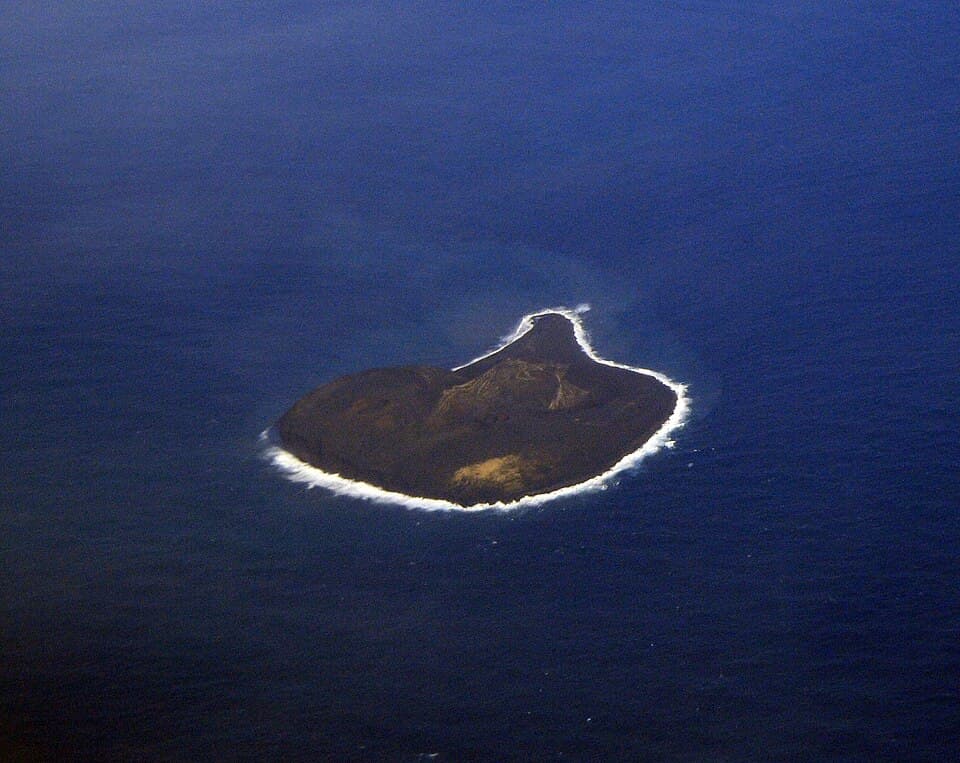
Key Facts
- On November 14, 1963, a cook aboard the trawler *Ísleifur II* spotted dark smoke rising from the sea and thought a nearby vessel was on fire. It was actually a new island erupting from the ocean floor, 426 feet below the surface.
- Surtsey was immediately declared a **nature reserve** and sealed off from human interference — making it the most pristine living laboratory ever created for studying how life colonizes bare rock.
- Only a **handful of scientists** are permitted to visit each year. Researchers must carry no seeds in their clothing, food, or equipment to avoid contaminating the experiment.
- The island's first vascular plant appeared in **1965** — just two years after the eruption began. Today, without any human seeding, Surtsey hosts **78 plant species and 89 bird species**.
- At its peak in 1967, Surtsey covered **2.7 km²**. By 2024, wave erosion had shrunk it to under **1 km²** — less than half its original size.
- Scientists estimate Surtsey could **vanish completely beneath the waves** within 100–200 years, unless new volcanic activity rebuilds it. It is, in a very real sense, a temporary world.
The Cook Who Spotted the Impossible
It was just after 7 a.m. on November 14, 1963, and the crew of the Icelandic fishing trawler Ísleifur II were going about their morning routine in the cold waters of the North Atlantic, roughly 20 miles south of the Westman Islands off Iceland's southern coast. The cook, whose name history has largely not preserved, glanced out at the sea and noticed something wrong: a column of dark smoke rising from the surface of the water.
His first thought was entirely reasonable. A boat was on fire. He alerted the captain.
But as the trawler changed course and drew closer, the crew realized there was no boat. The smoke — which was not smoke at all but ash and steam — was rising from the ocean itself. The sea was boiling. The ship's cook had just become one of the first humans to witness the birth of a new island.
Far below, 426 feet beneath the surface of the Atlantic, the ocean floor had cracked open. A volcanic fissure in the Mid-Atlantic Ridge system was pouring out lava at enormous volumes. The eruption had actually been underway for several days, building material upward through the water column, but it was only on the morning of the 14th that the accumulation breached the surface. Within days, the column of erupting material was two miles high — visible from the Icelandic mainland.
Icelandic geologists arrived within hours. Among them was Sigurdur Thorarinsson, director of the Geological Department of the Icelandic National Museum of Natural History, who documented the scene in extraordinary detail. The island was named Surtsey — after Surtur, the fire giant of Norse mythology who comes from the south bearing flames at the end of the world. The name felt appropriate.
Three and a Half Years of Fire
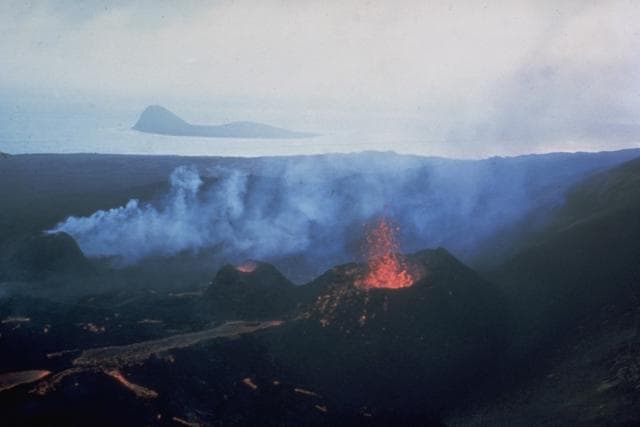
The eruption continued for three and a half years — far longer than most volcanic events of this type. The first phase, lasting through the winter of 1963-64, was the most dramatic: violent steam explosions, towering ash columns, and the rapid building of a fragile tephra cone above sea level. This loose material was vulnerable to erosion. Several other nearby submarine eruptions around the same time produced islands — Syrtlingur, Jólnir — that rose above the surface briefly before being washed away.
Surtsey survived because of what happened in April 1964: lava effusion began. Once molten rock started flowing from the crater and hardening into solid basalt on contact with the ocean, the island gained a durable armoring. The loose tephra beneath was protected. The island became permanent.
By the time the eruption ceased on June 5, 1967, Surtsey had reached its maximum size: approximately 2.7 square kilometers, with peaks reaching 174 meters above sea level. It was, by geological standards, a newborn — a piece of the Earth's surface that had never existed before, never been touched by rainfall, never hosted a microorganism, never known a blade of grass.
Scientists had been watching, and waiting, for exactly this moment.
The Forbidden Island
The Icelandic government made a decision that, in retrospect, was one of the most scientifically farsighted acts of the 20th century: they immediately declared Surtsey a nature reserve.
The logic was straightforward. Here was a piece of the planet's surface that was, in the most literal sense, sterile. No soil, no life, no history. If scientists could study it undisturbed — watch life colonize it from scratch, without the contaminating influence of humans tracking in seeds on their boots or introducing organisms deliberately or accidentally — they would have something no researcher had ever had: a controlled long-term experiment in how ecosystems form from absolute zero.
The rules were strict from the beginning and remain strict today. Visiting Surtsey requires a permit from the Surtsey Research Society, the body that has coordinated scientific work on the island since its formation. Tourists are prohibited entirely. Researchers are limited to small groups and short stays. Before boarding any vessel to the island, scientists must ensure their clothing, food, and equipment carry no seeds — every zipper checked, every pocket emptied. Fruit and vegetables that might contain viable seeds are banned. The goal is to keep Surtsey's colonization as natural as possible, so that every new species that arrives can be documented as having gotten there without human help.
The number of people who have ever set foot on Surtsey is extraordinarily small — a few hundred scientists over six decades, each visit documented and each researcher briefed on the protocol. It is one of the most restricted pieces of land on Earth: not because of military secrecy or political control, but because of the desire to let a wild process run without interference.
The result has been one of the longest continuous ecological studies ever conducted — and a window into how life, given time and bare rock, builds a world.
Year Zero: The First Arrivals
Scientists began monitoring Surtsey in 1964, while the eruption was still underway. The early reports were predictably barren: fresh lava, cooling ash, sterile sand. But not for long.
The first colonizers arrived almost immediately — and they were not what most people would imagine. Before any plant, before any animal, the island was claimed by bacteria. Bacterial colonies were detected in 1964, probably arriving on wind currents or ocean spray. Moulds and fungi followed. These were the pioneer organisms, beginning the long slow work of breaking down rock and building the very first traces of what might one day become soil.
In the spring of 1965 — less than two years after the island emerged — something remarkable happened. On the northern shore of Surtsey, a botanist found a single living vascular plant: Cakile arctica, a species of sea rocket. It had arrived, presumably, as a seed carried by ocean currents. It was growing in volcanic sand with no soil, no established nutrient cycle, nothing but rock and sea air. It was the first plant in the history of Surtsey.
By the end of the first decade, ten species of vascular plants had established themselves on the island. In 1967, the first moss species arrived. In 1970, the first lichens appeared on the lava. The parade of firsts continued: the first flies (blown in on wind), the first ground beetles, the first spider (which can travel remarkable distances suspended on silk threads in the upper atmosphere). Each arrival was documented, its likely route of colonization analyzed.
The island was beginning to breathe.
The Birds That Built an Ecosystem
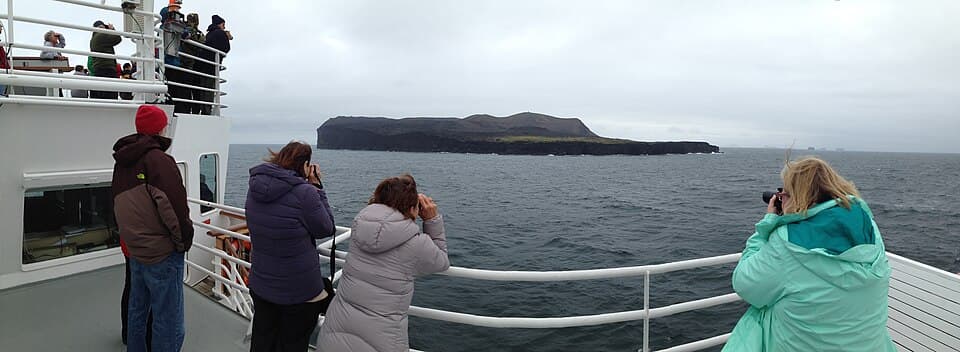
The most transformative development in Surtsey's ecological history didn't come from the sea or the wind. It came from the air — specifically, from seabirds.
Birds first began nesting on Surtsey about three years after the eruptions ended. The northern fulmar and the black guillemot were among the earliest nesters, establishing colonies on the rocky terrain. But the most significant arrivals were the gulls — particularly herring gulls and lesser black-backed gulls — which began forming nesting colonies in the late 1970s and 1980s.
The effect was transformational, and scientists watching it happen have described it as one of the most striking examples of how a single species can engineer an environment. The gulls brought several things Surtsey desperately needed. They brought nutrients, in the form of prodigious quantities of guano deposited on the bare rock and slowly building into nitrogen-rich proto-soil. They brought seeds, carried in their digestive systems from feeding grounds across Iceland and deposited in their droppings on the island. And they brought organic matter — feathers, food scraps, nesting debris — that accelerated the development of soil.
A 2025 study confirmed what botanists had long suspected: the vast majority of the 78 vascular plant species now growing on Surtsey arrived via birds, not wind or ocean currents. Most of those plants lack the obvious long-distance dispersal adaptations — no parachute seeds, no floating husks — that one might expect on an isolated island. They got there the way the gulls go everywhere: by eating something somewhere else and landing on Surtsey when they needed to rest.
Today, Surtsey hosts 89 documented bird species, 57 of which breed elsewhere in Iceland. The gull colonies have created patches of verdant green in an otherwise stark volcanic landscape. Under those patches, earthworms have been found — the first recorded in 1993 — processing the accumulated organic material into genuine soil. What was bare basalt 60 years ago is, in places, becoming something that deserves to be called earth.
The Island Is Shrinking
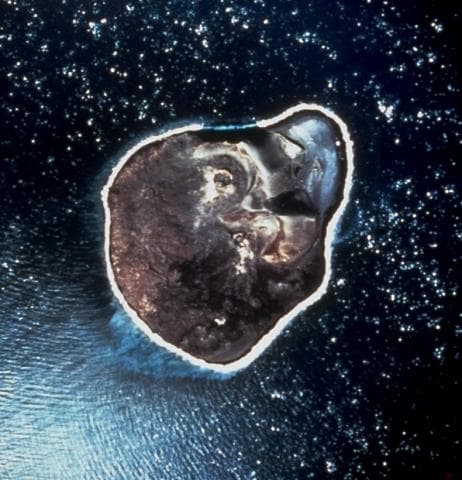
There is a bittersweet dimension to Surtsey's story that becomes more apparent with each passing decade: the island is losing the race against the ocean.
When the eruption ended in 1967, Surtsey covered 2.7 square kilometers. The lava armor protected it from immediate destruction, but the North Atlantic is relentless. Wave erosion attacks the coastline constantly. Storm surges cut into the cliffs. The tephra and ash layers that the lava doesn't protect erode rapidly. By 2012, the island had shrunk to 1.3 square kilometers. By 2024, it had dropped below 1 square kilometer — less than 37 percent of its peak size.
Scientists have calculated that, at the current rate of erosion, Surtsey will disappear beneath the waves within 100 to 200 years. The timeline depends heavily on whether any new volcanic activity occurs — another eruption could rebuild the island's bulk and restart the clock. Without that, Surtsey is counting down.
This gives the research on the island a certain urgency. Every annual survey is a data point in an experiment with a hard deadline. Every plant species catalogued, every bird colony monitored, every soil sample analyzed is one more piece of the record before the ocean reclaims what the volcano built. The scientists who visit today are not just studying an island in progress — they are archiving it.
There is also something almost philosophically apt about the impermanence. Surtsey appeared without warning from the sea. It has spent six decades demonstrating the tenacity of life, the ingenuity of seeds, the architectural ambitions of seabirds. And then, in geological terms not much longer from now, it will return to where it came from — leaving only the data, the papers, and the accumulated knowledge of what it takes to build a world from nothing.
What Surtsey Teaches Us
After more than six decades of observation, what has Surtsey actually told us — about life, about ecosystems, about the planet?
The first lesson is about dispersal. The conventional picture of island colonization — seeds blowing on wind, floating on ocean currents to distant shores — turns out to be dramatically incomplete. Birds are the primary architects of Surtsey's botanical landscape, and probably of island ecosystems far more broadly than previously understood. The implication reaches well beyond Surtsey: when we think about how isolated habitats are populated, we may have systematically undervalued the role of mobile animals as seed vectors.
The second lesson is about soil. Soil, which we tend to treat as a background condition, is actually a product — something that has to be built, layer by layer, by generations of organisms processing bare rock into something more hospitable. Watching that process on Surtsey in real time, from absolute zero, has given soil scientists data they could not have gotten any other way. The gull colonies turned out to be not just birds nesting on a rock but ecosystem engineers, manufacturing the substrate that everything else would depend on.
The third lesson is about time. Ecological succession — the process by which a barren landscape transitions through stages toward a mature, complex ecosystem — takes longer than most people intuitively appreciate, and it is not linear. There are setbacks, dead ends, unexpected arrivals, local extinctions. Sixty years of observation on Surtsey has produced the best continuous dataset ever assembled for primary succession, and researchers are still finding surprises.
And then there is the fourth lesson, which is harder to quantify but perhaps the most important. Surtsey is a reminder that life is not fragile — it is relentless. Given bare rock, a cold subarctic sea, an eroding volcanic island with no shelter, no soil, no nutrients, and no direct human assistance, life arrived anyway. It found a way in, as it always does. The question was never whether. The question was only how.