The Plant That Made Rome Rich, Inspired the Heart Symbol, and Vanished Forever
For seven centuries, the most valuable crop in the Mediterranean only grew on one narrow strip of Libyan coastline. Then, one morning, there was none of it left.
Key Facts
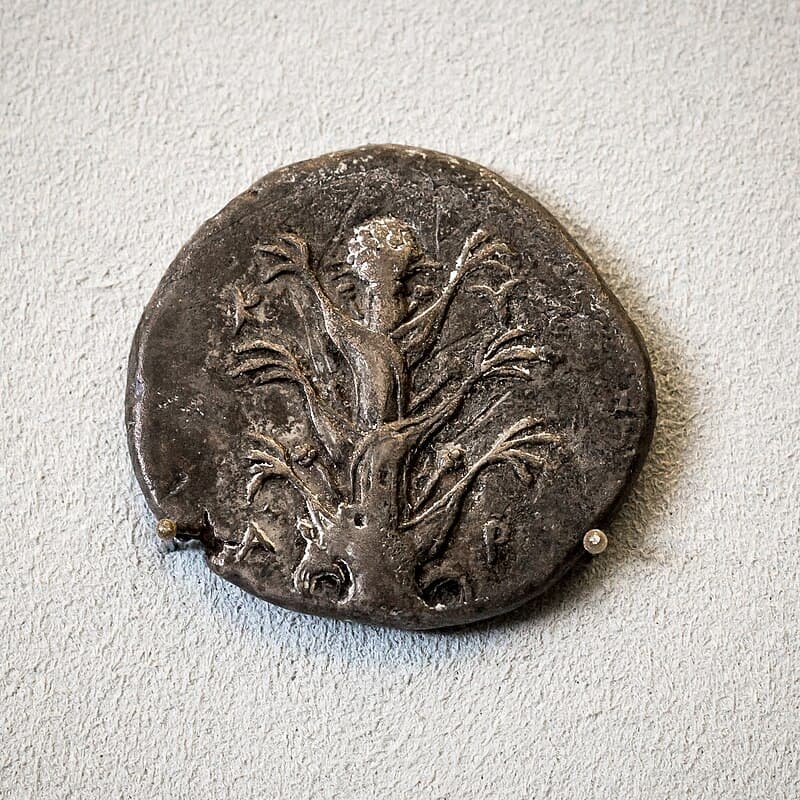
- Cyrene, founded in **631 BCE**, became one of the wealthiest cities in the Mediterranean on the back of a single plant that grew only on a 125 × 35-mile strip of the Libyan coast.
- Julius Caesar seized **1,500 pounds of silphium resin** from the Roman treasury in 49 BCE to help finance the civil war against Pompey — a hoard as strategic as a modern state gold reserve.
- Cyrenian coins depicted the plant's seed pod as a **stylised ♥**, more than two thousand years before the shape came to mean romantic love.
- Pliny the Elder reported the last stalk was sent **to the Emperor Nero as a curiosity**, making silphium the first human-caused species extinction recorded in writing.
- In 2021, a Turkish researcher named **Mahmut Miski** went public with a claim that he'd found silphium still growing in the foothills of a volcano in Cappadocia — 800 miles from its supposed only home.
A plant worth more than silver
The Greeks who founded Cyrene in 631 BCE had not, according to legend, wanted to be there. The story told by Herodotus is that a drought on their home island of Thera became bad enough that they asked the Oracle at Delphi what to do, and the Oracle told them — somewhat unhelpfully — to colonise Libya. It took them two attempts and a long detour by way of an offshore island called Platea before they finally settled on the mainland, on a limestone plateau about ten miles from the North African coast, in what is now eastern Libya.
What they found waiting for them, growing wild among the indigenous Libyan population, was a plant they had never seen before.
The Greeks called it silphion. The Romans would later call it silphium, or laserpicium, or sometimes just laser, after the golden-yellow resin the plant produced when its stem was cut. Within a couple of generations, that resin was the reason ships were putting into Cyrenian ports from across the Mediterranean. Within a couple of centuries, silphium would transform 'a small colony on the coast of Libya,' in the words of one historian, 'to one of the wealthiest in the Mediterranean.'
Herodotus, writing in the 5th century BCE, described the Cyrenians as being too busy with harvests to worry about much else: 'harvesting occupies the people of Cyrene for eight months of the year.' The region produced three staggered seasons — grain, vegetables, and silphium — but silphium was the star. It was what made the coins.
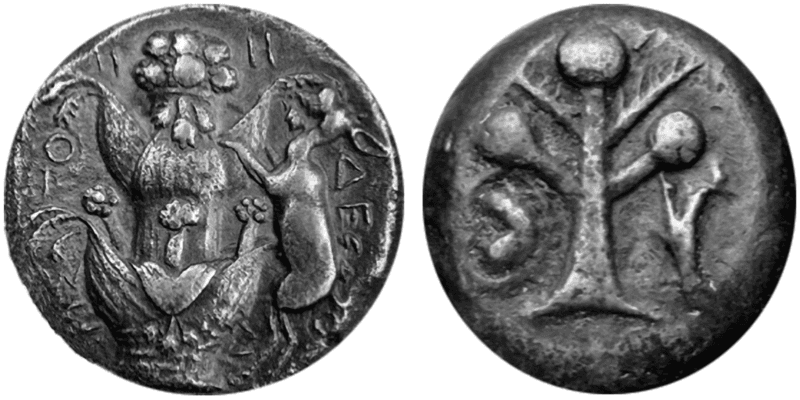
And there are a lot of those coins. For about four hundred years, running from the late 6th century BCE to the 1st century CE, Cyrene struck currency that was as saturated with its cash crop as a modern trade city might be with ship or crane motifs. Silver didrachms, tetradrachms, bronze coins, gold fractions — almost all of them had silphium on at least one face. Often the plant was rendered in painstaking detail: the thick ribbed stalk, the umbels of tiny flowers, the cluster of seed pods at the top.
Those seed pods are the reason we're going to come back to February 14th in a minute.
What it actually did
To understand why silphium was worth its weight in silver, you have to appreciate that the ancient world did not have a clean separation between a spice, a perfume, a medicine, and a recreational drug. Silphium was all four at once.
As food, it was everywhere. The surviving Roman cookbook Apicius uses silphium — or its cheaper imported cousin, asafoetida — in dozens of recipes: in sauces for braised meats, in broths, in sausages, in dressings for roasted vegetables. The playwright Antiphanes, in the 4th century BCE, has one of his characters run through a list of things he'll miss about a place he's leaving, and silphium makes the cut alongside horses and chariots. It was, in other words, deeply normal — a staple on wealthy tables and an aspirational condiment on everyone else's.
As medicine, it was a cabinet all by itself. Hippocrates prescribed it for coughs, sore throats, fevers, indigestion, aches, and — in a detail you don't forget once you've read it — as a poultice for protruding intestines. Pliny's Natural History lists silphium as a treatment for snake bite, epilepsy, warts, dog bite, pleurisy, jaundice, and gout. It was used as a digestive and as a cure for flatulence, which probably deserves some kind of honorary status in pharmacological history given that the Romans also used it to make beans palatable.
But the use that really moved the market — and the use that has kept silphium in the modern imagination — was sexual.
Soranus of Ephesus, the leading gynecologist of the Roman Empire, wrote in the 1st century CE that a woman could 'drink the silphium juice with water once a month' as both a contraceptive and an abortifacient. 'It not only prevents conception,' he claimed, 'but also destroys anything existing.' He also described its use as a pessary — a small amount of the resin soaked into wool and inserted after intercourse. The poet Catullus, trying to explain to his lover Lesbia how many kisses would be enough, name-dropped the silphium-growing hills of Cyrene as a unit of measurement: as many kisses as there were grains of Libyan sand 'that lie between the oracle of sultry Jupiter and the sacred tomb of old Battus.' Several scholars read this as a quiet wink — essentially, we have enough contraceptive for all of them.
Whether silphium actually did what Soranus claimed is one of those questions we'll never fully settle, because there are no samples left to test. But the marketplace voted: people paid for it, repeatedly, for centuries, and they did so at prices that make our most aggressive luxury goods look like bargains.
Julius Caesar's strategic reserve
Here's the detail that tends to stop people cold when they first encounter it: in 49 BCE, when Julius Caesar crossed the Rubicon and started the civil war against Pompey, one of the first things he did in Rome was raid the state treasury. Among the assets he seized was 1,500 pounds of silphium resin.
Not gold. Not silver. Not weapons. Resin.
Caesar could do this because silphium was kept in the treasury in the first place — because the Roman state literally regarded a particular Libyan plant's secretions as a component of its strategic reserve. The resin was so valuable that it was traded by weight, often against silver, sometimes described as being worth its weight in gold, and in at least a few accounts, seed by seed.
By way of comparison: 1,500 Roman pounds is about 491 kilograms. At the prices ancient sources imply, that single bulk withdrawal was roughly the equivalent of several tons of modern saffron. It was the kind of asset you raid specifically because it's dense, portable, and universally accepted — a currency you could hand to mercenaries or foreign kings and know they'd take it.
The Cyrenian economy had, by that point, been built and rebuilt around this single export for more than five centuries. Thera had produced a colony; the colony had produced a dynasty (the Battiads); the Battiads had produced wealth; and all of it, in the end, traced back to this one narrow strip of coast where a particular plant would — and nowhere else, ever, would — grow.
The heart on the coin
This is the part where you start looking at your phone differently.
If you pick up a well-preserved Cyrenian tetradrachm from the 5th or 4th century BCE, you will see, on the obverse, a thick ribbed stalk with flower umbels and a cluster of seed pods. And if you look carefully at the seed pods — especially on higher-denomination coins, where the engraver had more room — the shape is unmistakable: a pair of rounded lobes joined at the top, coming to a point at the bottom. A heart.
Not a stylised abstraction of an anatomical heart — the real human organ is famously lumpy and asymmetrical and doesn't look much like the symbol at all. Something closer to a drawing of a heart. The ♥ you tap on Instagram. The shape on the side of a box of Valentine's Day chocolates.
This is a theory, not a proven fact. But it's a theory with unusually good evidence for it. The heart shape we use today is a late medieval invention — it doesn't show up clearly in European art until the 13th or 14th century CE, and its appearance there is weirdly sudden and weirdly complete. One long-running school of thought, first proposed in the mid-20th century and revived by cultural historians in the 2000s, argues that the shape was imported — a pagan Mediterranean image that got christianised, repurposed as a symbol of affection, and then, much later, commercialised beyond recognition.
The Cyrenian coins are the main piece of hard archaeological evidence for that theory, because they pre-date the medieval heart by more than 1,500 years, they depict something that is clearly meant to be a seed pod and not an organ, and they come from a city whose export was associated — explicitly and repeatedly by ancient writers — with sex, love, and fertility. The resemblance to the modern heart emoji is not subtle.
Meanwhile, if you want to see a real silphium seed pod today, your best bet — bizarrely — is to look at a modern Ferula plant's fruit under a microscope. The mericarps of Ferula drudeana, the leading modern candidate for silphium's identity, are described in botanical literature as 'papery' and 'heart-shaped.' Which brings us to the part where this story stops being a safe, wistful historical vignette and starts getting weird again.
How to lose a species
For most of the classical world's history, silphium had a strange double identity: desperately valuable, and stubbornly uncooperative. It would not grow where it was planted. Theophrastus, writing in the 4th century BCE, noted that people had tried repeatedly to cultivate silphium outside of Cyrenaica, and had failed every time. The plant seemed to require a specific combination of soil, climate, and — some modern botanists think — a specific microbiome that existed only on that 125-by-35-mile strip of Libyan steppe.
The consequence was that the entire world supply had to be harvested wild, from a single place, every year, forever.
This worked, more or less, for about six centuries, because the Battiad kings and later the independent Cyrenian government treated silphium as a managed resource. Harvesting was regulated. Shepherds were kept out of the silphium fields — the Greek writer Arrian notes that 'sheep are very fond of silphium,' and would dig up the roots with their hooves if given the chance. Quotas existed. Prices were controlled. The plant's range was famously fixed but its yield, within that range, was held stable by a kind of crude but functional resource stewardship.
Then, in 96 BCE, the last Ptolemaic king of Cyrenaica died without an heir, and bequeathed the province to Rome.
The next seventy years were what you would expect from a provincial administration with short time horizons and a mandate to maximise revenue. Rome leased out the silphium lands to tenant farmers. Those tenants held the fields under renewable contracts and were charged, effectively, by the pound of resin delivered. The system rewarded extraction and punished restraint.
Pliny the Elder, who was alive when the extinction became obvious, wrote with real bitterness about what happened. Read his complaint carefully: it is, essentially, a complaint about negative externalities in a sharecropping lease structure. It is an ancient Roman aristocrat noticing, with fury, that a commons had just been enclosed and stripped, and that the state had incentivised the enclosure.
By the late first century CE, Pliny wrote, silphium was effectively gone. 'Within the memory of the present generation,' he noted, 'a single stalk is all that has ever been found there, and that was sent as a curiosity to the Emperor Nero.'
Nero is thought to have ruled from 54 to 68 CE. That means a single plant, the last known example of the species, was carried from Libya to Rome sometime in those fourteen years. We don't know what happened to it after that — one stray reference in a later source says it was eaten.
So ends, as far as anyone can tell, the first extinction of a biological species that was recorded in writing by the humans responsible for it.
Those who hold the lands there on lease have come to the conclusion that it is more profitable to depasture flocks of sheep than to preserve the silphium for the use of man.
— Pliny the Elder, Natural History, Book XIX, c. 77 CE
The reason it couldn't be farmed
There's a strand of modern botanical thinking, championed most recently by the Royal Botanic Gardens at Kew, that tries to answer a simpler question: why did silphium refuse to leave its home range?
The leading hypothesis is that silphium was a sterile hybrid. Many plants in the genus Ferula can interbreed, but the offspring of some crosses are infertile — they can produce leaves and flowers and resin, but their seeds don't germinate. If silphium was such a hybrid, then every individual plant was, genetically, the last of its line. The species persisted only because the hybridisation event kept re-occurring naturally in Cyrenaica — the same two parent species met and crossed, year after year, because both happened to grow in that narrow zone.
Take that hybridisation away — by pulling up the mother plants, or by overgrazing the region with sheep, or by the gradual desertification of North Africa that paleoclimate records confirm was accelerating during the late Republic — and the supply doesn't slowly dwindle. It collapses all at once. One generation, there is silphium. The next, there is dust.
This also explains why ancient cultivators kept failing. You cannot 'domesticate' a sterile hybrid. You can only protect the conditions under which it keeps being born.
A claim from Cappadocia
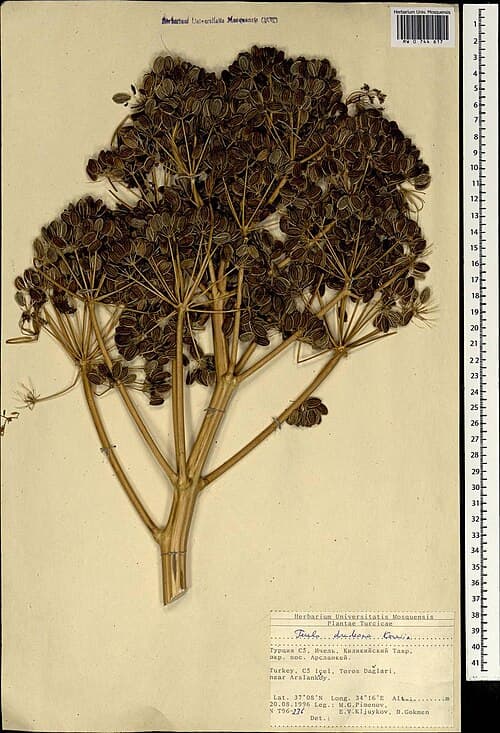
In 1983, a young Turkish pharmacologist named Mahmut Miski was doing field work in the foothills of Mount Hasan, a dormant volcano in central Turkey, when he noticed a plant he didn't recognise. It was a giant fennel — clearly a Ferula — but it didn't match any of the local species. It had thick, branching roots that looked like ginseng. It had grooved, hollow stalks. It had yellow umbels of flowers at the top, and at the end of the season it produced heart-shaped, papery seed pods.
Miski collected specimens, sent samples off for identification, and was told the plant already had a name: Ferula drudeana. It had been first described in 1909 by a German botanist and named as a new species by a Russian taxonomist in 1930. Almost no one had studied it since.
Miski studied it. For most of the next four decades, quietly, whenever he had funding. He found that it grew in only a handful of tight populations around Mount Hasan, almost all of them near ancient Greek and Roman settlement sites — places where, plausibly, ancient colonists might have brought seeds with them. He found that it produced a resin rich in medicinal compounds, including at least thirty secondary metabolites with documented pharmacological activity. He found that it appeared 'suddenly after spring rains,' matching Theophrastus's description of silphium springing up in the wake of storms.
In 2021, after decades of accumulated evidence, Miski published a paper laying out the case that Ferula drudeana is — or is descended from — the lost silphium of Cyrene. The paper included a comparison of his plant to the coinage, a chemical profile of its resin, and a colourful ethnobotanical detail: food historian Sally Grainger prepared an ancient Roman recipe using the resin Miski collected, and reported that it produced, in her words, 'an intense green flavour' that outperformed the asafoetida usually substituted for silphium in modern reconstructions.
Not everyone is convinced. The medieval scholar Alain Touwaide has pushed back, arguing that geographical proximity to former Greek colonies is suggestive but not sufficient, and that a truly convincing identification would need to demonstrate not just that Miski's plant resembles the ancient one but that specific ancient medicinal claims can be reproduced in its chemistry. There's also the problem that Ferula drudeana is growing 800 miles from Cyrene, with no known continuous historical presence in Libya, which makes the 'it's still alive' framing a little fraught. What Miski has, at best, is a plant that may be the same species as silphium, or that may be a close genetic cousin, possibly transplanted in antiquity from the now-lost Libyan populations.
If he's right, the story of the first recorded human-caused extinction might need a different ending: not gone, but refugee — surviving in a foreign country because somebody, two thousand years ago, thought to carry seeds.
Why it still matters
There are two ways to read the silphium story, and both of them are worth holding at once.
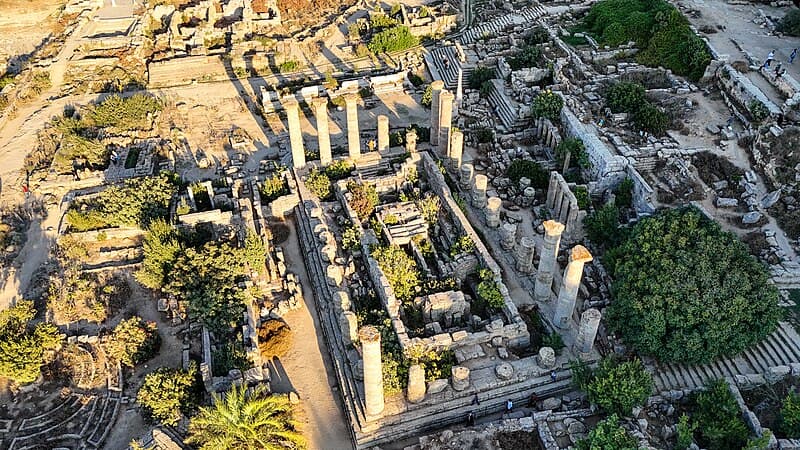
The first is as a cautionary tale about the fragility of economies built on single extractive resources. Cyrene was rich for as long as it had silphium, and when the plant was gone, the city did not quietly diversify; it declined, slowly and then all at once, until its temples were eroded columns standing on a plateau above the sea. Modern parallels are not subtle. Kew's own discussion of silphium notes that contemporary crops like coffee, bananas, and chocolate are nearly as genetically narrow as silphium was botanically narrow, and that their continued existence depends on a small number of closely-related cultivars that are themselves under climate stress.
The second reading is about what happens when a culture loses a piece of itself and keeps using the shape of the missing thing anyway. Every time you tap the heart on a message, or doodle one in the margin of a notebook, or stamp one onto a box of Valentine's candy, you are, in one plausible reading of the evidence, drawing the seed pod of a plant that went extinct in the 1st century CE, carried forward by a chain of copyists and engravers and printers who no longer remembered what the original was. The symbol detached from its referent and just kept travelling.
That's worth sitting with. We tend to think of extinctions as hard lines — a species is alive, and then it isn't. The silphium story suggests a fuzzier edge. The plant itself has been gone for two thousand years. But something about it — its resin, maybe, in Cappadocia; its outline, certainly, in every messaging app on earth — is still in active use. A quarter of the global population sent it to someone this year.
Which is, as extinction afterlives go, not a bad one.