Pando: The Trembling Giant That Is One Tree, 47,000 Stems, and Possibly Dying
One tree. 47,000 trunks. Six thousand metric tons. And it may be dying.
Key Facts
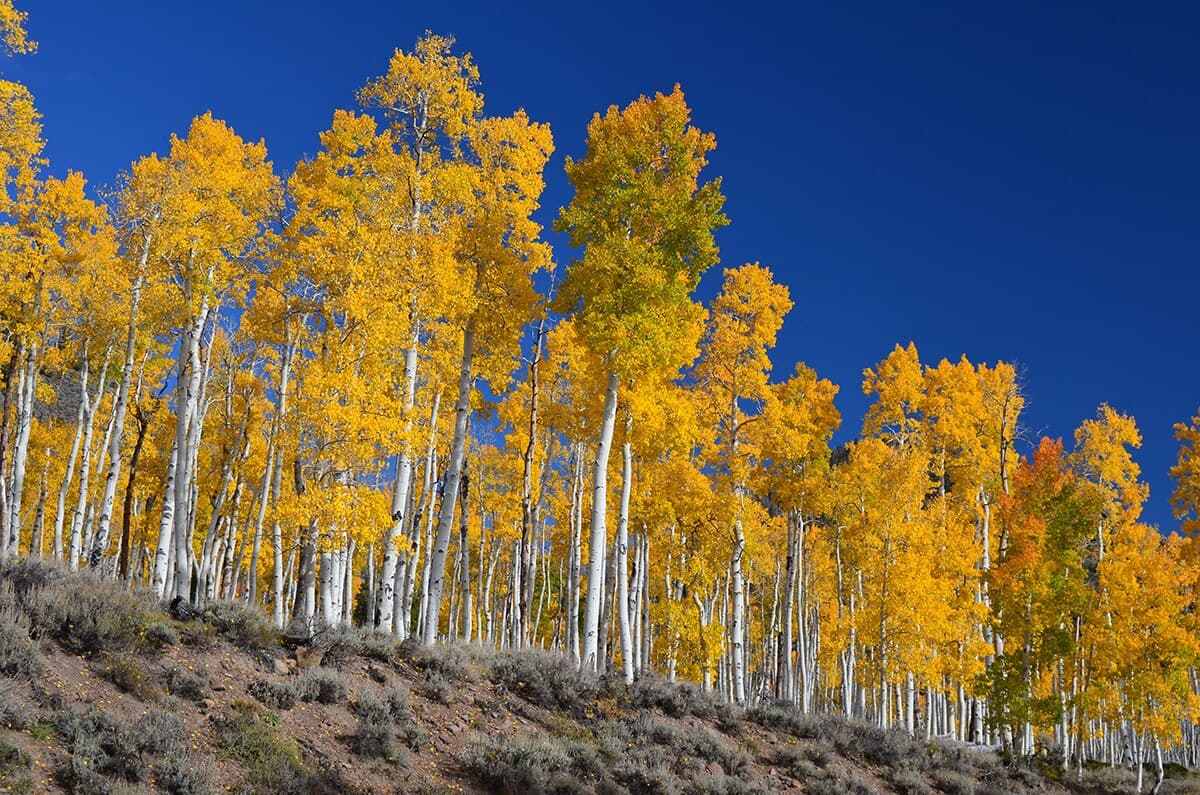
- Pando is a single male quaking aspen (*Populus tremuloides*) in Fishlake National Forest, Utah, with about **47,000 above-ground stems** sharing one root system across **106 acres**.
- It weighs roughly **6,000 metric tons**, making it the world's heaviest known organism by mass.
- Estimates of its age range from **9,000 to 16,000 years**, with a 2024 somatic-mutation study suggesting up to **80,000 years** is theoretically possible.
- It was identified as a single clonal organism by Kemperman and Barnes in **1976**; named 'Pando' by Michael Grant in a **1993** Discover Magazine essay.
- Across the past 30–40 years, gaps have opened in the canopy. New stems are being eaten by mule deer faster than they can grow. There are **almost no middle-aged trees** in the entire grove — only old ones and freshly-browsed sprouts.
- In **September 2025**, the U.S. Forest Service finished new fencing that brings about **80% of Pando's land area** under protective enclosure.
What 'one tree' actually means
Aspens reproduce in two ways. The first is the way most trees do — flowers, seeds, wind, dispersal, sprout. The second way is what makes Pando possible: vegetative cloning. An aspen's roots send out lateral runners called suckers, which break the surface and grow into new trunks. Those trunks are not the children of the parent tree. They are the parent tree, displaced upward by a few feet of dirt. The genetic material is identical. The vascular system is shared. They draw water and sugar from one common pool.
You can see this in any aspen grove if you look. Whole hillsides will turn yellow on exactly the same week — sometimes the same day — because they're not separate trees responding individually to autumn light. They're one organism doing one thing across a hundred acres at once. In Pando, every trunk is male. Every trunk is the same age in genetic terms. And every trunk is connected, beneath the soil, to roots that diverge and merge and diverge again until you cannot meaningfully say where one begins and another ends.
The genetic test that confirmed Pando's identity is conceptually simple. You take leaf or bark samples from a few hundred trunks scattered across the grove, and you sequence them. If they came from separate seed-grown trees, you'd find normal genetic variation. In Pando, the samples are essentially identical — some have a handful of somatic mutations that crept in as the root system grew across millennia, but the underlying genome is the same one, photocopied across an entire forest.
There aren't really 47,000 trees there. There is one tree, with 47,000 places where it sticks up out of the ground.
— Paul Rogers, ecologist, Western Aspen Alliance, paraphrased from a 2018 PBS interview
How a forest got named
People had been walking through Pando without realizing it for thousands of years. Ute and Paiute peoples used the area for centuries. Mormon settlers grazed cattle there starting in the 1850s. The Forest Service drew its boundaries in 1907. None of them noticed that the trees on the south slope above Fish Lake were one organism, because at the surface there is no way to tell. They just look like aspens.
That changed in 1976, when two ecologists from Michigan, Jerry Kemperman and Burton V. Barnes, published a quiet paper in the journal Botanical Gazette arguing that an unusually uniform aspen grove in Utah was almost certainly a single clone. They had measured the trunks, looked at leaf shape, recorded bud break and fall coloration, and noticed that the entire grove behaved as a unit. DNA testing was still a decade away, but the case was strong enough that the grove started showing up in textbooks under the technical label 'the Fishlake clone.'
It got its name in 1993, when the geneticist Michael Grant wrote a short editorial for Discover Magazine proposing that the world's largest organism deserved a proper name. He picked Pando, Latin for 'I spread,' because that was what the tree had been doing — slowly, generation by generation, sucker by sucker — for as long as anyone could measure. The name stuck. By 2006 the U.S. Postal Service had put it on a stamp.
How old is old?
The age question is genuinely hard. Individual aspen trunks live about 100 to 130 years, so if you ring-count a Pando trunk you'll get a number that bears no relationship to the age of the organism. It's like dating a person by counting the days since their last haircut.
Better methods exist, but they're indirect. You can estimate from the spread rate — how fast the root system extends each year — and back-calculate how long it must have taken to cover 106 acres. That gives a number in the rough vicinity of 10,000 years. You can look at pollen records in nearby lake sediments to establish how long aspens have been continuously present at this elevation, which helps bracket the answer. And, most recently, you can use somatic mutation accumulation: cells dividing through tens of thousands of years pick up tiny copying errors at a roughly constant rate, so by sampling stems from across the grove and counting the differences, you can estimate how long the lineage has been alive.
A 2024 preprint applying the somatic-mutation method came out with a range of 16,000 to 80,000 years, with the central estimate well above the older textbook number. The high end isn't strongly supported, but the low end is. Even at 9,000 years, Pando predates the wheel. At 80,000, it predates anatomically modern humans leaving Africa. There is no other organism on Earth that we know of, plant or animal, that has lived as a continuous individual for that long.
The deer, the wolf, and the ghost cascade
Here is what's happening on the ground. An aspen trunk lives about a century. Pando, like any aspen clone, is supposed to be replacing those trunks continuously. The way it does that is by sending up suckers in the spring — thin, tender shoots, two or three feet tall by midsummer, which over the next decade thicken into adolescent trees and eventually into mature trunks. In a healthy aspen grove, you find a mix of all ages. In Pando, you find old trees and you find sucker-tops chewed off at six inches, and almost nothing in between.
The chewers are mule deer. Some elk and cattle, but mostly mule deer. Deer love aspen sprouts the way humans love asparagus tips. And there are far more deer in central Utah than the landscape can support, because the carnivores that used to keep them in check are gone. Wolves were exterminated from Utah by the 1930s. Cougars are heavily hunted. The deer eat the saplings, the saplings die, the canopy gets older and thinner, and eventually a 14,000-year-old organism gets nibbled out of existence.
This is what ecologists call a trophic cascade: a missing link at the top of the food chain reaching down through every level. The most famous example is Yellowstone, where the 1995 reintroduction of wolves caused elk to stop loitering in the river bottoms, which let willows recover, which let beavers come back, which restored riparian wetlands. Pando is the same story running in the opposite direction. The wolves are gone. The cascade falls.
The Forest Service has been working on this since the 2010s. In 2013 they fenced off about 16% of the grove to exclude deer. Inside that fenced area, the suckers grew. Saplings reached two meters, then three. Outside the fence, sucker-tops were nibbled flat. The fence works. The problem is that fencing is expensive, fencing alters the landscape, and fencing isn't a long-term solution for a clone that needs to keep regenerating for the next ten thousand years.
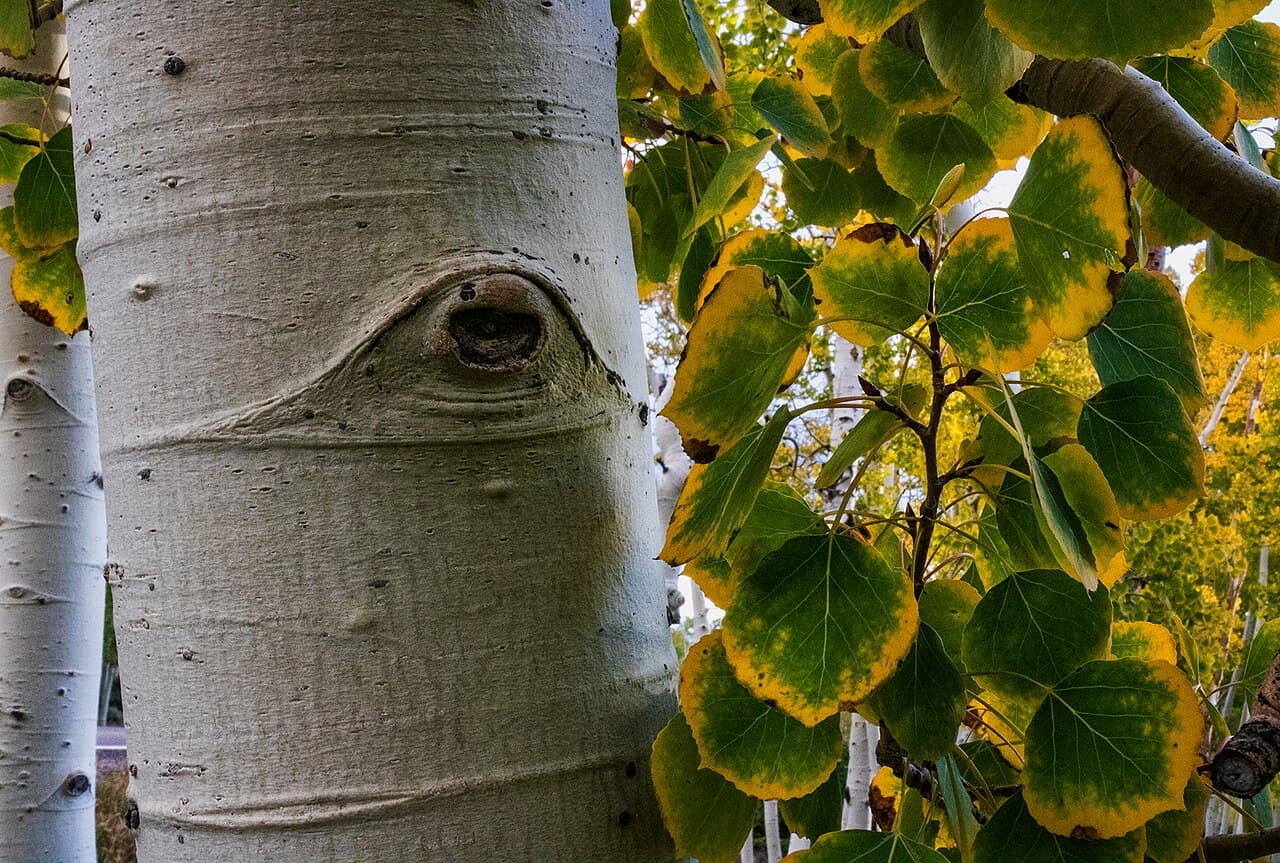
Pando is sending up plenty of new growth. The problem isn't reproduction. The problem is what's standing there waiting to eat that new growth before it can become a tree.
— Paul Rogers, in National Geographic, 2018
September 2025: 80% inside the fence
In late 2025 the Forest Service finished a long-running fencing project that now encloses roughly 80% of Pando's footprint. The remaining 20% — areas where fencing was impractical because of terrain or visitor access — has been managed with two simplified 'wildlife management bulwarks,' which are essentially deer-funnel structures designed to push the herd toward exits and away from the grove.
It is too early to call this a success. The previous 16% fenced area has shown clear regrowth, but Pando does not respond on human timescales. A new generation of trunks takes thirty to fifty years to mature. The earliest evidence that the new fencing is working — meaning, the earliest year you'd see meaningfully more middle-aged trees in the grove — is probably the 2050s. The earliest year a kid born today could walk through Pando and see a forest in obvious recovery, with adolescent trunks shoulder-high among the old ones, is probably the 2070s.
That's a strange thing to write, but it captures what conservation looks like when the organism in question measures its life in millennia. The interventions are decade-scale. The outcomes are century-scale. The mistakes are reversible only by the next generation, if at all.
What it sounds like
Pando does not just look like one organism. It sounds like one. In 2018, a sound artist named Jeff Rice and the conservation group Friends of Pando dropped a hydrophone — an underwater microphone — into a hollow at the base of one of the trunks during a windstorm. The microphone was open to the root cavity but sealed against the air. What it recorded was extraordinary.
Over the course of the recording, you can hear a low, continuous rumble. It rises and falls with gusts of wind. The wind is moving the trunks, and the trunks are connected to the roots, and the roots are vibrating against each other and against the soil. A single shake at the canopy is transmitted through forty thousand stems and forty thousand miles of cumulative root, and the entire system hums.
It is not a metaphor. In a clonal organism, mechanical force does propagate through the entire body. When wind hits one corner of Pando, the whole tree feels it.
The philosophical part you don't have to read
Pando makes a lot of biologists uncomfortable, because Pando makes the word organism harder to use cleanly. We tend to imagine an organism as a discrete unit with a beginning, an end, a body, and a perimeter you can draw a line around. Pando has all of those, technically. But its beginning is forty thousand years ago. Its body is buried. Its perimeter changes every year. And its 'trunks' are interchangeable parts that the organism can grow, shed, replace, and regrow at will.
Some biologists prefer the term genet for what Pando is — a single genetic individual — and reserve organism for things you can pick up and weigh in one piece. Others argue that an aspen clone is closer to a colony of genetically identical animals (think of Portuguese man-of-war, which is also technically a colony) than to a tree. The honest answer is that biology has many edge cases, and clonal organisms like Pando are one of them, and the language we use for 'what counts as alive' was never built to handle a 6,000-ton genetic individual that has been continuously growing since the last ice age.
You can take comfort, if it helps, in the knowledge that Pando does not have any opinions on this question. It is just spreading.
What to take from this
There is a temptation in pieces about Pando to lean hard on the elegiac note — the largest organism on Earth, dying quietly, undone by the absence of wolves. That story is real and it's worth telling. But the more interesting thing is what Pando teaches you about how life works at long timescales.
One: individuality is a convention. The boundary between 'one organism' and 'many' is something we draw because it's useful for a forty-foot-tall, eighty-year-lived primate. Push the timescales out to ten thousand years and the boundaries blur. Pando is on the far side of the blur, and it has things to teach about what continuity means.
Two: resilience is rarely a property of the organism alone. Pando survived the end of the Pleistocene, the Holocene climatic optimum, the entire history of human civilization, the dust bowl, two world wars, and the introduction of cattle to Utah. It is now in trouble because of an ungulate population that exists because we removed the predators that used to limit it. The organism is fine. The ecosystem is what's broken. You can't save the tree without fixing the system.
And three: conservation has to operate on the relevant timescale, not the convenient one. The fencing project finishing in 2025 will not produce visible results within the lifetime of any current employee of the U.S. Forest Service. The rangers who started this work will retire before they see whether it worked. That isn't a failure of management. That is just what taking care of a 14,000-year-old organism looks like.