Olo: The Color That Shouldn't Exist
Five people on Earth have seen a color that no human eye has ever perceived in nature — a blue-green so impossibly saturated it makes the world's most vivid teal look washed out.
Key Facts
- Only **5 people** have ever seen olo — a handful of researchers and study participants at UC Berkeley.
- It requires a **custom laser system** called "Oz" that individually targets up to 1,000 retinal cone cells at once.
- Olo is described as a **"profoundly saturated teal"** — like the greenest green, but with a saturation that has no equivalent in the natural world.
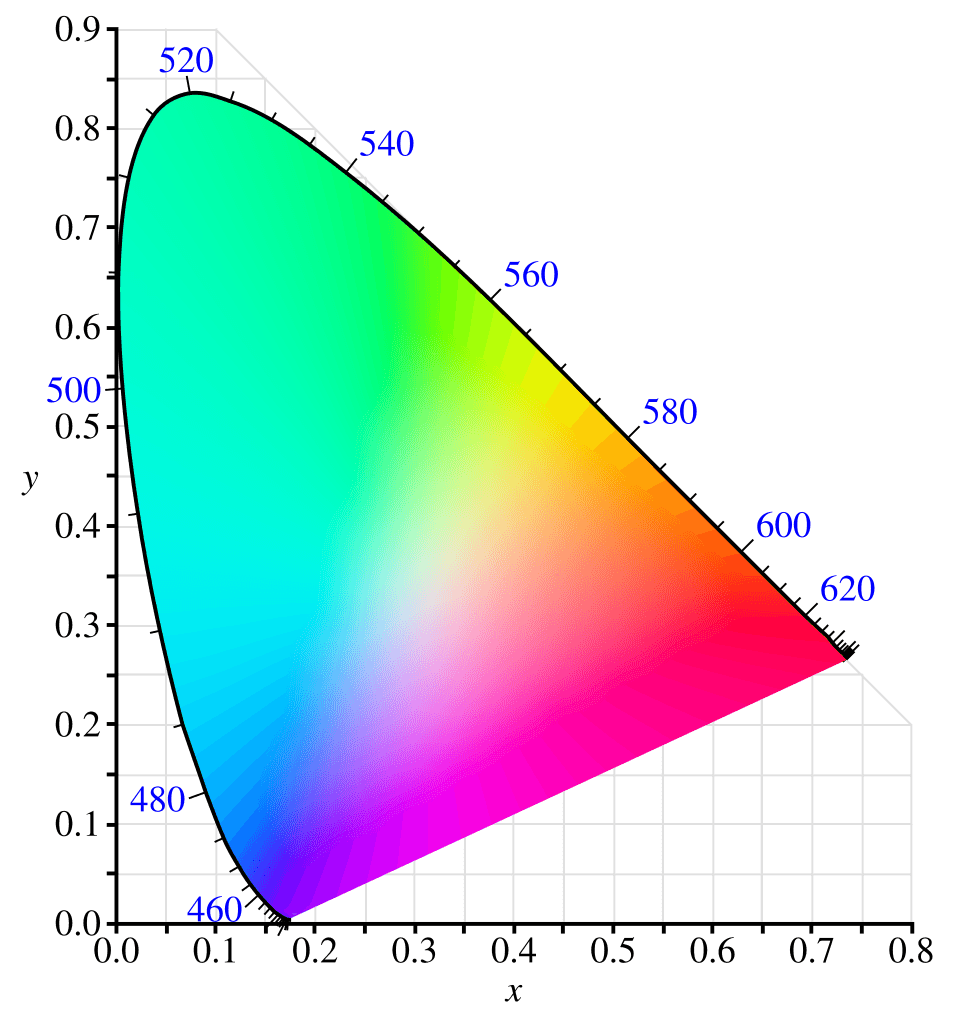
- The closest digital approximation is hex **#00FFCC**, but participants say this is dramatically less saturated than the real thing.
- The color was published in the journal *Science Advances* in April 2025 by a team led by Austin Roorda and Ren Ng at UC Berkeley.
The Most Saturated Color You Will Never See
Imagine the richest, most vivid teal you've ever seen — the shimmering blue-green of a peacock feather, the electric flash of a tropical fish, the neon glow of bioluminescent plankton at night. Now imagine all of that compressed into a single patch of light so intensely saturated that everything you've ever called "vivid" suddenly seems pale by comparison.
That's the closest anyone can get to describing olo. And the frustrating thing — the philosophically dizzying thing — is that no screen, no paint, no physical light source can actually show it to you. The closest digital representation, hex code #00FFCC, falls laughably short. Participants in the study said the real thing made that color look "like a washed-out shadow of itself."
In April 2025, a team of researchers at UC Berkeley published a paper in Science Advances announcing something that sounds like it belongs in a science fiction novel: they had created an entirely new color, one that exists outside the normal boundaries of human vision, and they had shown it to five human subjects using a laser system that bypasses the normal rules of how eyes work.
The color's name is olo. Only five people on Earth have ever seen it. And understanding why takes you deep into one of the most fascinating quirks of human biology: the reason all of your colorful world is built on an elegant but surprisingly narrow trick.
Three Pigments, Infinite Colors — And One Enormous Blind Spot
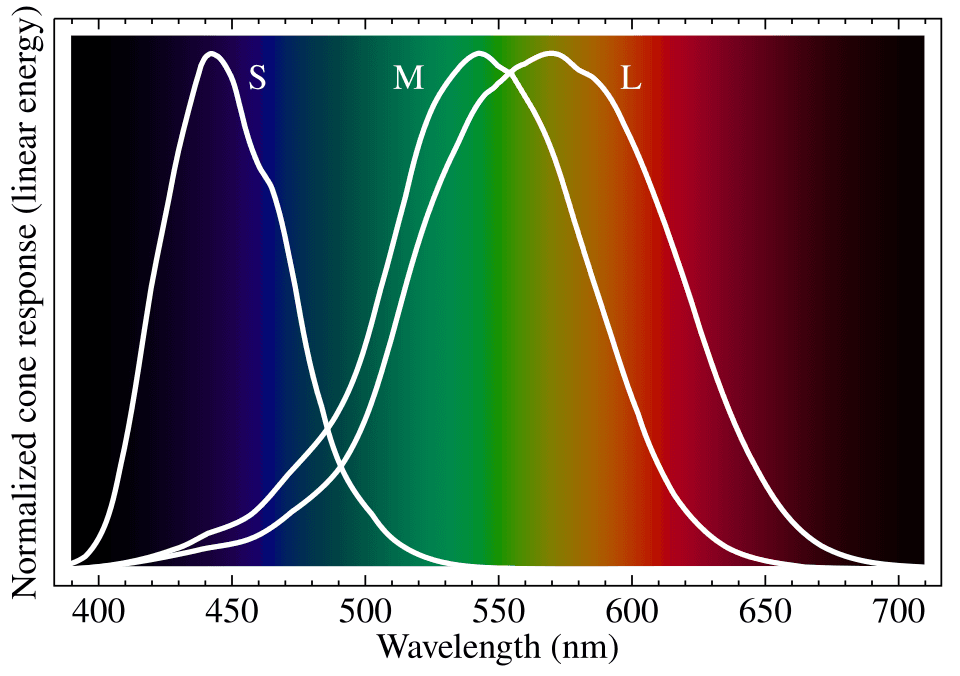
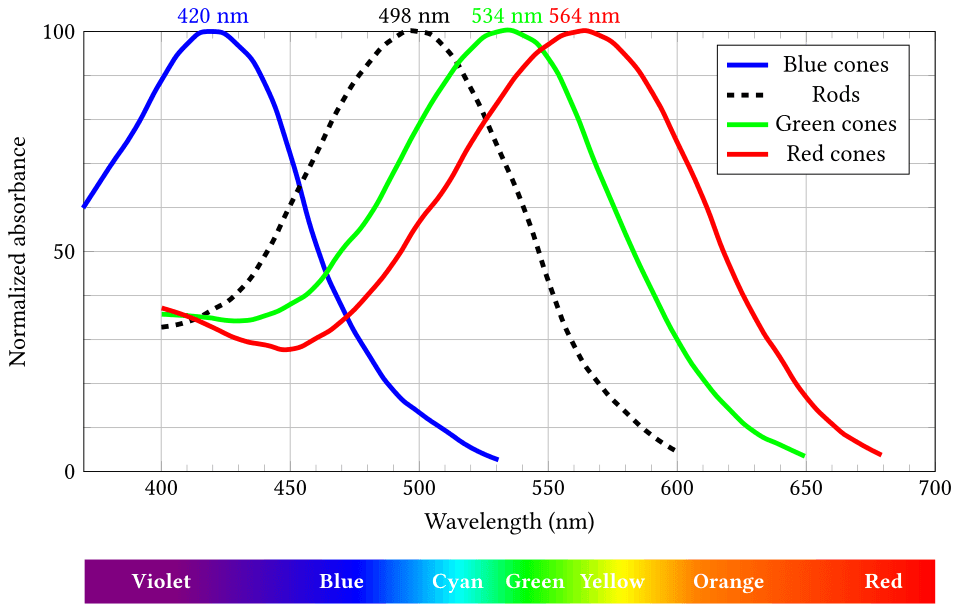
Your eye contains two types of photoreceptors: rods, which work in dim light and see in grayscale, and cones, which handle color. You have three types of cones, each sensitive to a different part of the light spectrum. The short-wavelength cones (S cones) respond primarily to blue light. The long-wavelength cones (L cones) favor red. And the medium-wavelength cones (M cones) peak somewhere in the green range, around 543 nanometers.
The brain reads color by comparing the relative firing rates of all three cone types. When your L cones fire much more than your M or S cones, you see red. When M and S fire together and L fires less, you see blue-green. The entire rainbow — every sunset, every flower, every traffic light — is built from ratios of just three numbers.
Here's the catch that makes olo possible: the sensitivity curves of these three cone types overlap enormously. The M cones and L cones in particular have highly similar response curves, both peaking in the green-to-yellow range. This means that in any natural lighting condition — or any artificial light, including computer screens — you cannot stimulate only the M cones. When you look at green light, your L cones are firing too. When you look at anything, all three cone types respond to some degree.
This isn't a bug in your visual system. It's an extraordinarily efficient design that allows three simple detectors to map out a rich color space. But it does mean there are certain combinations of cone stimulation that are, in principle, possible — stimulating only M cones, for instance — that never actually occur in normal vision. Your brain has never received that signal. It doesn't know what color it would look like, because it has never had to.
The Machine That Hacks Your Retina
The technology that made olo possible is called Oz — named, charmingly, after the land behind the curtain where things aren't what they seem. It was developed by a team led by Austin Roorda, a professor of optometry and vision science, and Ren Ng, a computer science professor, both at UC Berkeley. The system is a masterpiece of adaptive optics: a laser platform that can track the motion of a living eye fast enough to continuously retarget individual photoreceptor cells in real time.
The human eye is never completely still. Even when you're trying to hold your gaze perfectly steady, your eye makes tiny involuntary movements called microsaccades — rapid, jittery shifts of a fraction of a degree that happen several times per second. These movements are largely invisible to your conscious experience but pose an extraordinary engineering challenge for anyone trying to hit specific cells on your retina with a laser.
Oz solves this with a high-speed tracking system that continuously monitors eye position and adjusts the laser targeting to compensate, fast enough to maintain lock on individual cone cells even as the eye wiggles. The system can simultaneously control up to 1,000 photoreceptors, stimulating some and not others, all in real time.
To see olo, study participants had to sit very still with their heads held in place by a bite bar — the kind used in eye exams to keep your head from moving. Their eyes were tracked, the laser was fired in carefully calculated microdoses of 543-nanometer green light, and only M cones were stimulated. S and L cones received no signal at all.
Olo appeared as a patch of light roughly five times the apparent size of the full moon in the sky — visible only for seconds at a time before blinking reset the motion tracking system and the color vanished. When it reappeared, participants said the same thing: this is nothing like anything I have ever seen before.
We can paint whatever we want on the retina. We can make spots, we can make patterns, we can make colors. We can do things that regular light simply cannot do.
— Austin Roorda, UC Berkeley professor of optometry and lead researcher on the Oz project
What Olo Actually Looks Like (Or Doesn't)
Here is where the story becomes genuinely difficult to tell, because language was built for a world where everyone sees the same colors. There is no word for olo because no one has needed one before now. The five people who've seen it have done their best.
They describe it as a blue-green — peacock green, teal, somewhere between cyan and green on the spectrum. But the descriptor that comes up every single time is saturation. Participants said that olo was more saturated than any color they had ever encountered — that it made the most vivid natural colors seem washed out and pale in comparison. One researcher called it the most saturated natural color and said it "just looked pale." Another said it was like seeing color in a way they had never imagined possible, like the volume being turned up past maximum.
The researchers conducted over 200 color-matching experiments with the five participants, asking them to try to recreate olo using conventional light sources — screens, projectors, filtered light. They couldn't. Every attempt fell short. The closest conventional approximation, hex #00FFCC, is a clean teal — pleasant, vivid even — but participants consistently described it as dramatically less intense than the real thing.
This is part of what makes olo so philosophically interesting: it's not a trick of the mind, not an optical illusion, not a hallucination. It's a genuinely new signal arriving at the visual cortex — one that no human brain has ever received before in the natural world. The brain, encountering this unprecedented input, reports something unprecedented. A new color.
This Isn't the First Time Scientists Have Tried to Break Color
The concept of colors that exist outside normal human perception has a long and delightfully strange history. Scientists have explored "impossible colors" — also called chimerical or forbidden colors — for decades.
One well-known class of impossible colors exploits opponent processes in the visual system. Human color vision is built partly on opponent channels: red vs. green, and blue vs. yellow. Because of this opponent wiring, your brain literally cannot process "reddish green" or "yellowish blue" — these combinations cancel each other out in the neural pathway before they even reach conscious perception. But some researchers have found tricks to get glimpses of these forbidden hues: stare at a saturated color long enough to fatigue the cones, then shift your gaze to a neutral field, and the opponent channel briefly swings past its normal range.
There are also "stygian colors" — colors that appear both saturated and extremely dark at the same time, something that normal physics doesn't allow. And "self-luminous colors" — colors that seem to emit light even when they clearly aren't.
What makes olo different from these historical curiosities is permanence and reproducibility. Chimerical colors are fleeting afterimage phenomena — they last seconds, they're hard to control, and they can't be precisely measured or shared. Olo, by contrast, is a stable, reproducible, measurable perceptual experience that can be delivered on demand by the Oz system. It's not a trick. It's an actual new entry in the catalog of human color experience — one that requires hardware to access, but is real in every meaningful sense.
Why This Matters Far Beyond Color Theory
The researchers who built Oz weren't primarily trying to create a new color. Olo was a proof of concept, a side effect of something far more ambitious: a platform for understanding and treating diseases of the eye at the level of individual photoreceptors.
Diseases like age-related macular degeneration, retinitis pigmentosa, and Stargardt disease all involve the progressive loss of specific photoreceptors. One of the hardest things about treating these conditions — or even understanding them — is that it's extremely difficult to simulate what patients experience. How much of the M-cone population has been lost? What does it actually look like to see through a retina that's missing 20% of its L cones?
Oz can answer those questions directly. By selectively stimulating or withholding stimulation from specific cone types, the system can mimic the exact perceptual effect of various forms of cone loss. For the first time, doctors could potentially understand their patients' visual experience from the inside — and calibrate treatments not just by measuring visual acuity on a chart, but by actually modelling the subjective experience of vision.
The system also opens the door to entirely new approaches to vision restoration. If Oz can selectively stimulate specific cone populations, future versions might be able to compensate for lost cones by stimulating remaining ones in carefully calibrated patterns — a retinal prosthetic that operates not at the level of electrodes or implants, but at the level of individual photons hitting individual cells.
We can simulate virtually any pattern of cone loss, which means we can finally understand what our patients are actually seeing — and not just infer it from tests.
— Ren Ng, UC Berkeley professor and co-creator of the Oz platform
The Bigger Picture: What Else Are We Missing?
The existence of olo raises a quietly unsettling question that goes well beyond retinal neuroscience: if our visual system is capable of perceiving something that simply never occurs in the natural world, what does that say about the relationship between perception and reality?
Your brain doesn't experience the world directly. It receives electrical signals from sensory organs and constructs a model of reality from those signals. The model is extraordinarily detailed and useful — good enough to navigate, hunt, build civilizations, make art. But it is always, at some level, a representation. And representations can only represent what the sensors have been tuned, by evolution and experience, to detect.
Olo reveals that your visual cortex is capable of more than evolution ever needed to put into practice. The neural machinery for processing pure M-cone stimulation was sitting there, unused, waiting — not because it serves a purpose, but because it's an inevitable byproduct of how cone signals are processed. It's a color your brain could always have experienced, but never had reason to.
This isn't unique to vision. There are frequencies of sound too high for any natural predator to have required ears to hear, flavors that no natural food contains but which receptors can detect, bodily sensations that only arise from stimuli that never appeared in the ancestral environment. Our senses are tuned for survival, not for completeness. The map is not the territory. And sometimes, given the right tools, you can step off the edge of the map.
The Oz team is already working on the next generation of the system, with plans to expand the number of simultaneous photoreceptor targets from 1,000 to potentially tens of thousands. As the platform becomes more sophisticated, it may become possible to create entire visual scenes that fall outside the normal color gamut — landscapes, portraits, abstract art, rendered in hues that no canvas, screen, or natural light source can reproduce.
For now, olo remains a private experience shared by five people, a color so saturated it defies description, flickering in and out of existence in a darkened room at UC Berkeley while a laser paints it, cell by cell, onto the back of a human eye. It is, in the most literal possible sense, a color you had to see to believe.