The City of Darkness: How Kowloon Walled City Became, and Unbecame, the Densest Place on Earth
Thirty-three thousand people. Six and a half acres. Zero effective government. One postman in a plastic hat.
Key Facts
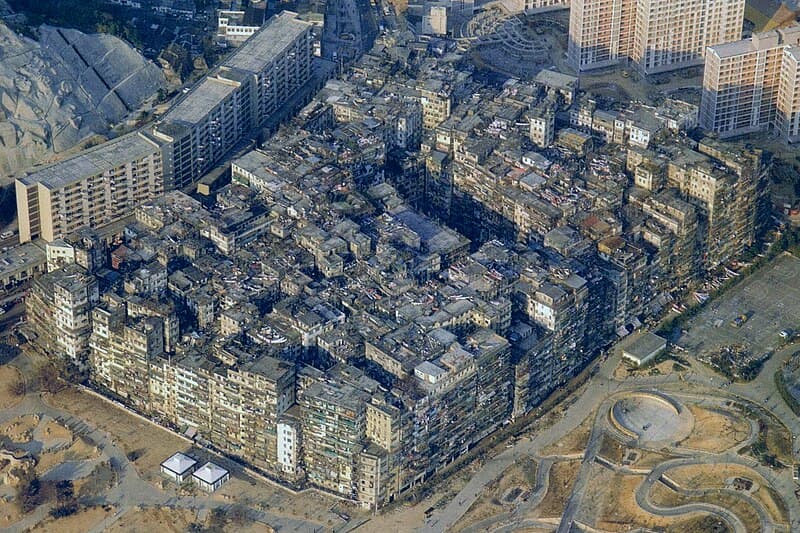
- At its peak in the 1980s, Kowloon Walled City packed roughly **33,000 people into 2.6 hectares (6.4 acres)** — a population density of about **1.25 million people per square kilometer**, the highest ever recorded anywhere on Earth.
- It existed because of a **single sentence in an 1898 treaty** that excluded the old Qing military fort from the lease of the New Territories to Britain, creating a pocket of Chinese territory sealed inside colonial Hong Kong that neither government would administer.
- For much of the 20th century it was effectively **self-governing by triads**, with over 150 unlicensed dental practices, opium dens, brothels, and noodle factories — until a **1973–74 police crackdown** broke organized crime's hold after 3,500+ raids.
- The whole city drew water from only **eight municipal pipes** and pirated nearly all its electricity. Upper floors were wider than lower floors to catch sunlight. The postman wore a plastic hat because the overhead tangle of pipes dripped constantly.
- Britain and China **jointly agreed to destroy it in 1987**. It was photographed obsessively in its last years, filmed in for a Jackie Chan movie during the eviction, and finally dynamited in 1994. Kowloon Walled City Park, a Qing-style garden, stands on the site today.
A postman with a plastic hat
Start with the postman. For decades, if you wanted to reach a resident of Kowloon Walled City, your letter would end up in the hands of one of a rotating handful of Royal Mail couriers who had made the place their beat. The postman needed, as every documented account of him notes, a waterproof hat — because above his head, running along every corridor and stairwell of the city, was a dense overhead tangle of pipes that had been welded, jammed, and retrofitted into the buildings over forty years. Most of them leaked. Some of them always leaked. The alleys, which in the daytime got almost no sunlight because the buildings above them had been built outward and joined together at the top, were known to residents as a perpetual drizzle under an electric-cable sky.
The postman got to the buildings. The doctors and the dentists and the noodle-factory owners went to work. Children played on the rooftops. Planes coming into Kai Tak airport, 800 meters away, came in so low over the city's roofline that you could read the airline names on them. None of this was supposed to be happening. By any conventional measure, Kowloon Walled City was not supposed to exist at all. For about a hundred years it did anyway — and when the Hong Kong government finally pulled the plug on it in the late 1980s, they were tearing down what had become, in purely quantitative terms, the densest accumulation of human beings ever recorded in one place.
The accident
The story starts with a fort. In the Song dynasty, roughly a thousand years ago, the Chinese military placed a small outpost on the Kowloon peninsula to supervise the local salt trade. By the early 19th century it had dwindled to a sleepy coastal garrison — a few dozen guards, a low wall, a yamen office, some cannons pointing nowhere in particular. In 1847, after Britain took Hong Kong Island in the First Opium War, the Qing government panicked and reinforced the place: new stone walls 13 feet tall, six watchtowers, proper gates. They wanted a fortified Chinese military presence staring across the water at British Hong Kong.
Fifty years later, the calculation changed again. In the 1898 Convention for the Extension of Hong Kong Territory, China leased the New Territories to Britain for ninety-nine years. The negotiators drew a map. And in one of those clauses that seem minor at the time and then do not stop causing problems for decades, the treaty carved out the Kowloon Walled City as an explicit exception: the territory, but not the fort, would go to Britain. Qing officials could keep running the fort as long as they didn't interfere with British Hong Kong's defenses.
It was, in the diplomatic jargon of the time, a face-saving provision — give the Chinese court something to point to at home. The fort held about 700 people. No one seriously thought the clause would matter.
The Qing dynasty collapsed in 1912. Britain claimed ownership. China — first the Republican government, then the Nationalists, then eventually the Communists — periodically protested. The Foreign Office in London, trying to figure out what to do about the anomaly, wrote a memo in 1948 that is a small masterpiece of imperial pragmatism. The recommendation was that Britain should 'accept the principle of Chinese jurisdiction... but the Chinese agree not to attempt to exercise that jurisdiction in practice.'
In plain English: nobody was in charge. On paper, both powers claimed it. In reality, neither would pay for police, schools, water, garbage, or building inspectors. This turned out to matter a lot in 1945.
Refugees, fires, and the first hundred thousand cables
When the Japanese occupied Hong Kong during World War II, they demolished the stone wall of the Walled City and used the rubble to extend Kai Tak airport. The wall — the thing the place was literally named after — never came back. After 1945, as China descended into civil war and then into the upheaval of the early People's Republic, refugees poured south into Hong Kong. Most ended up in squatter camps scattered across the New Territories. But the Walled City attracted a particular subset: people who wanted to be somewhere the colonial police would not come, or could not come, or would not stay for long.
By 1947 there were about 2,000 squatters. In January 1950 a fire tore through the settlement, destroying more than 2,500 hastily-built huts and displacing almost 17,000 people. A persistent rumor — still repeated in local histories — is that the fire was set deliberately to clear the land for new construction by criminal syndicates. Whether or not that's true, what came after the fire was different from what had been there before. The shacks gave way to small concrete tenement blocks. By the late 1950s, triad gangs — especially the 14K and Sun Yee On — were running the brothels, gambling halls, and opium dens, and the Hong Kong police were happy to stay out.
The police officially had jurisdiction — a 1959 murder trial forced the Hong Kong courts to rule on the question and they said yes, the Walled City was under British Hong Kong law — but in practice, for the next decade and a half, officers entered the city only in very large groups and left before dark. The triads filled the gap.
Then, starting in 1973, something changed. The Independent Commission Against Corruption — the ICAC, set up in 1974 as part of Hong Kong's broader post-colonial cleanup — started coordinating with the Kowloon police to actually enforce the law inside the Walled City. Over about eighteen months they ran more than 3,500 raids, resulted in over 2,500 arrests, and seized more than 1,800 kilograms of drugs. The opium parlors closed. The brothels thinned out. By 1983, the district police commander was publicly describing the crime rate inside the Walled City as 'under control.'
The triads didn't vanish entirely. But organized crime stopped being the dominant form of authority inside the city, and in the space that opened up, something genuinely unusual happened: tens of thousands of ordinary people started getting on with their lives.
How a city that shouldn't work, worked
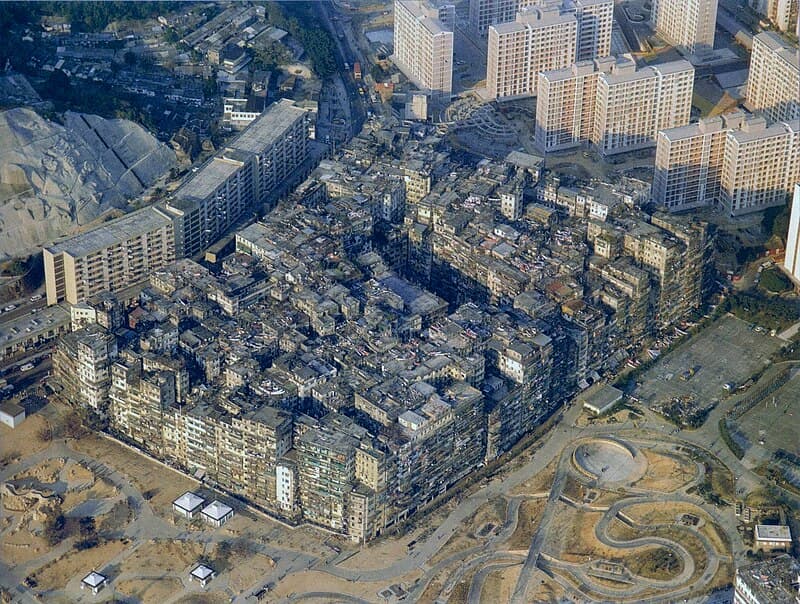
By the early 1980s Kowloon Walled City looked, from the outside, like a single enormous building. It wasn't. It was about 350 separate structures, 10 to 14 stories tall, built so tightly against each other that you could walk from one end of the city to the other — about 210 meters in the long direction — without ever setting foot on a street or feeling direct sunlight. The buildings had been independently designed and built by different owners, but their balconies and staircases and rooftops had fused together into one continuous fabric.
The height limit of 13–14 stories wasn't chosen for safety. It was chosen for Kai Tak, which was less than a kilometer away. Planes flying the infamous 'checkerboard approach' into Hong Kong's old airport came screaming in over the city at a steep bank. Any taller and they'd clip it.
Infrastructure was improvised on every axis. Water came from eight municipal standpipes that Hong Kong had grudgingly installed and from some deep wells on the site. From those eight taps, residents ran their own private plumbing: a three-dimensional tangle of metal and plastic pipes, most of them corroded, many of them leaking. Rooftop tanks, pumped up by small electric motors, provided storage for the upper floors. Electricity was almost entirely pirated — tapped from colonial power lines via a notorious mesh of aerial cabling. Sewage was, by most accounts, a polite fiction. Garbage was tossed out of windows into air shafts and hauled away by charities. Mail, as mentioned, got delivered.
The economy inside was, by the 1980s, surprisingly legitimate. The city was famous — and still is, among Hong Kong's Cantonese-speaking grandparents — for two things: unlicensed dentistry and fish-ball factories. Dentists who couldn't get a Hong Kong license set up clinics with glass storefronts that opened directly onto the ground-floor alleys. They were cheap and plentiful, and tourists still came to get their teeth cleaned there. Meanwhile, dozens of small food-processing operations churned out fish balls, dumplings, meatballs, and noodles. By one estimate, in the mid-1980s a third of the fish balls sold on Hong Kong streets came out of a Walled City kitchen.
Children went to school. Many went to regular Hong Kong public schools outside the city. Others attended small private schools run by church groups. The rooftops — all 300-odd of them, interconnected into a kind of upper plaza — served as playground, laundry line, social club, and the one place inside the city where the sun reliably reached you. Photographs from the era show kids doing homework at folding tables on the roof while a Boeing 747 banks past at shockingly close range.
Oral histories collected from the residents themselves tell a different story from the outsider view. The thing that comes up over and over is community. Rents were low. Neighbors knew each other because they literally shared load-bearing walls. When the next fire broke out — and they did, frequently — your neighbors were the first responders, because there was no way a fire truck was getting in.
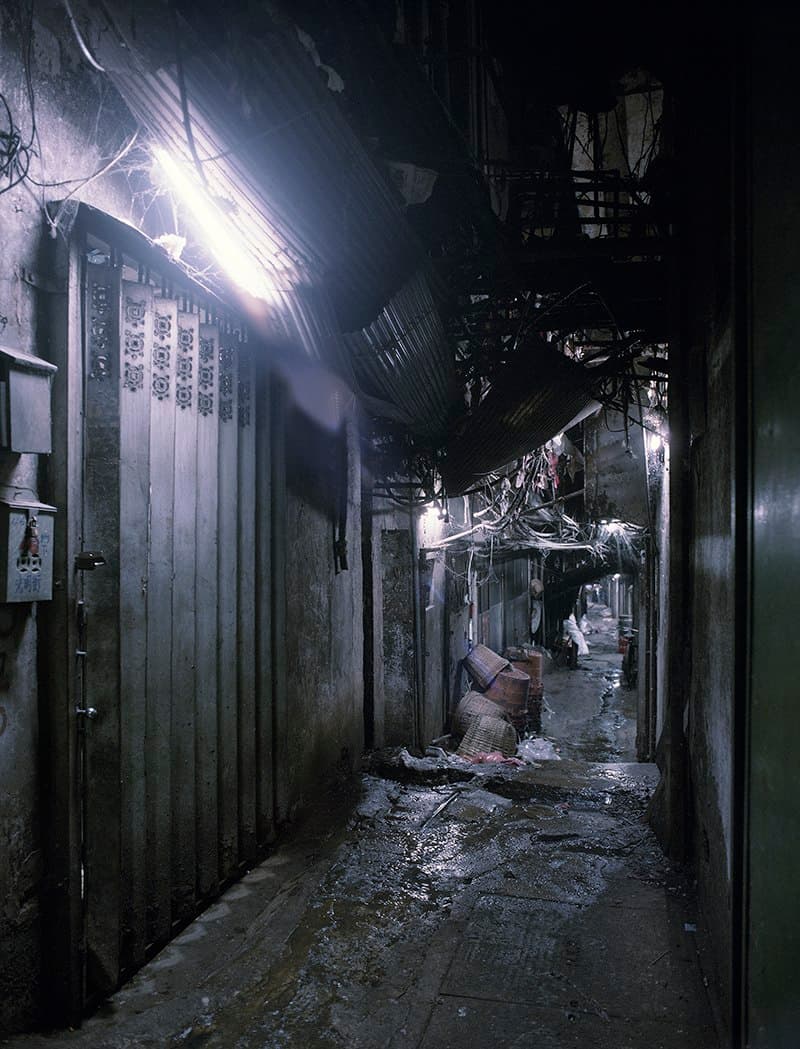
We walked along 'streets' no wider than my outstretched arms, with bare bulbs the only lighting and the electric wires obscuring the sky above us. Had we gone into the alleys branching off from that main artery, we would have seen the dark and ugly sides.
— A U.S. foreign service officer, recorded after a brief 1980s tour of the city
The decision to destroy it
In 1984, Britain and China signed the Sino-British Joint Declaration agreeing that Hong Kong would return to Chinese sovereignty in 1997. Both governments, for obvious reasons, wanted the awkward jurisdictional exception of the Walled City resolved before the handover.
On January 14, 1987, the Hong Kong government announced that the Walled City would be demolished and its residents resettled. The compensation package was unprecedented in scale: HK$2.7 billion — roughly US$350 million at the time — distributed to about 33,000 individuals and businesses. It worked out to something like US$10,000 per person, which in 1987 Hong Kong was enough for a reasonable deposit on a flat in a new tower somewhere in Kowloon or the New Territories.
It did not go smoothly. Many residents did not want to leave. A number of the old dentists had built up loyal clientele who would follow them nowhere else. The factory owners had infrastructure they couldn't take with them. There were protests. There were sit-ins. Forced evictions began in November 1991 and continued into July 1992.
The final residents were out by early 1993. For a few months the city stood empty, and in those months a film crew moved in: Jackie Chan's production company used the abandoned Walled City as a set for the 1993 film Crime Story. Some of the explosions you see in the final chase sequence of that movie aren't special effects. They are the actual demolition of the Walled City, starting March 23, 1993.
Demolition finished in April 1994. In its place the Hong Kong government built a quiet, formal Qing-style garden — Kowloon Walled City Park — that opened in December 1995. Two relics from the old place are preserved inside it: the restored yamen, the Qing magistrate's office that had sat at the center of the fort since the 1840s, and the foundations of the old South Gate. Two original cannons from 1802 sit in front of the yamen.
If you go to the park today, it's impossible to tell, standing among the bamboo and the koi ponds, that the most densely populated place in human history stood there thirty years ago. Which is, of course, entirely the point.
The afterimage
Kowloon Walled City has had a longer second life in culture than it had as a physical place. William Gibson wrote about it as a template for the cyberpunk megacity — 'a hive of dream,' in his phrase, a place where every surface had been colonized by activity. It's the direct visual inspiration for the slum levels of Blade Runner, the interior corridors of Tyrell Corporation, the arcade scenes of countless Japanese anime, the entire aesthetic of the video game Shenmue II, and — more literally than most people realize — a full-scale arcade replica in Kawasaki, Japan, that operated from 2009 to 2019 as a themed entertainment venue. The Call of Duty franchise has built three separate multiplayer maps on it. There is, at this point, an entire cottage industry of architects using the Walled City as a case study in emergent, bottom-up urbanism.
That reading is partly right and partly a fantasy. The Walled City was bottom-up, but only because the two governments that should have been on top refused to do their job. It was self-organizing, but it was also a place where, for a generation, the biggest employer was the heroin trade and the biggest fire hazard was your neighbor's illegal electrical splice. A third of its alleys were perpetual night. Tuberculosis and hepatitis rates were significantly higher inside than anywhere else in Hong Kong. One of the residents interviewed for the City of Darkness book put it more plainly: 'It was home. I don't miss it.'
What the Walled City actually demonstrates is narrower, and more interesting than either the utopian or the dystopian reading. It's this: given a patch of ground nobody is willing to govern, and a steady enough supply of people who need somewhere to live, humans will grow a city into that patch of ground. They will run water, they will pirate electricity, they will sort out who handles disputes, they will educate their children, they will deliver the mail. They will do it under terrible conditions and they will do it anyway, because the alternative is not doing it. And the thing they build, given a few decades, will be capable of sheltering so many lives per square foot that its population density will enter the historical record as a number that nobody has matched before or since.
Then, after a few decades, the governments will get around to remembering that the patch of ground exists, and they will tear it all down and plant a garden.