The Assembly Before Civilization
Deep in southeastern Turkey, hunter-gatherers carved a 17-meter amphitheater into solid limestone 11,000 years ago — 7,000 years before Rome, 5,000 years before Stonehenge. In 2025, archaeologists finally found it.
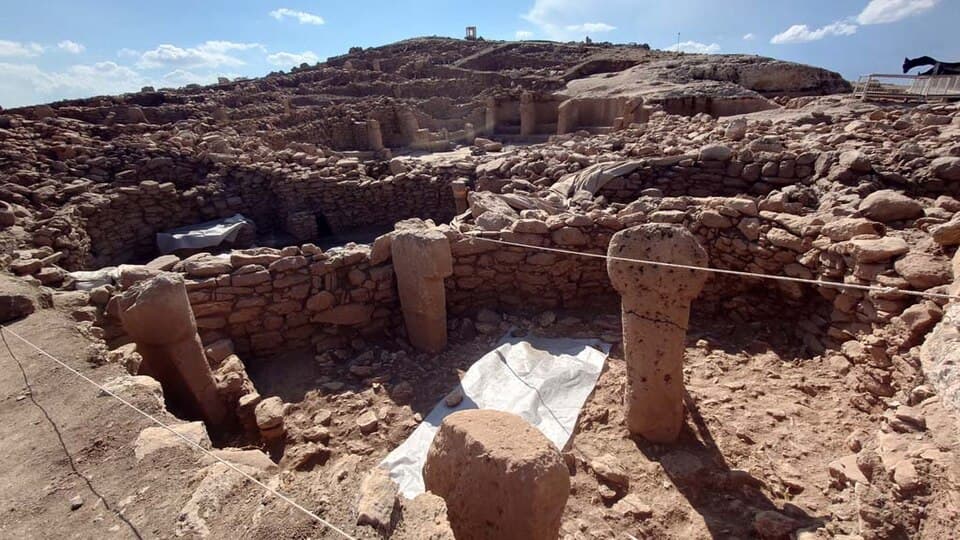
Key Facts
- Karahantepe's newly discovered amphitheater-like structure is **~17 meters in diameter**, with three wide tiered stone benches curving around a central focal point.
- The site dates to approximately **9,400 BCE** — predating Stonehenge by 5,000 years and the first Roman amphitheater by over 9,000 years.
- More than **250 T-shaped pillars** have been found in situ, along with the highest concentration of **human face carvings** known from the Neolithic era.
- It was built by **hunter-gatherers** — people who had not yet fully adopted farming — which overturns old assumptions that monumental architecture required settled agricultural society.
- Excavation director Professor Necmi Karul calls the amphitheater's tiered benches a design that 'continues in later eras as amphitheaters and odeums' — suggesting this is where communal gathering architecture was born.
- Karahantepe was **deliberately buried and abandoned** around 8,000 BCE, just like its neighbor Göbekli Tepe — suggesting a ritualized end to the site rather than simple abandonment.
- Named one of **Archaeology Magazine's top 10 discoveries of 2025**, Karahantepe is central to Turkey's ambitious Taş Tepeler (Stone Hills) project studying 12+ Neolithic sites simultaneously.
The Stone Room That Was Never Supposed to Exist
There is a moment in archaeology when a trowel meets something the earth was not supposed to hold. At Karahantepe in southeastern Turkey, that moment has been happening again and again for years — but in 2025, it produced something that no one quite knew how to categorize.
Carved into solid limestone bedrock, at a depth that placed its construction firmly in the tenth millennium BCE, archaeologists uncovered a circular space roughly 17 meters across. Three broad, tiered stone benches curved around a central focal point. Human sculptures — heads emerging from walls, seated figures positioned at ground level — watched from the periphery. At the center, the remnant socket of a prominent statue that no longer existed.
What do you call it? The excavation team reached for the closest word they had: amphitheater. But the Greek theaters of antiquity wouldn't exist for another 8,000 years. The structure at Karahantepe is so old that when it was already ancient, the civilizations we consider ancient hadn't yet begun.
This is the story of Karahantepe — a site that was named one of Archaeology Magazine's top 10 discoveries of 2025, and that is quietly dismantling everything we thought we knew about when and why humans first decided to gather together in dedicated spaces for purposes beyond pure survival.
Welcome to the Stone Hills
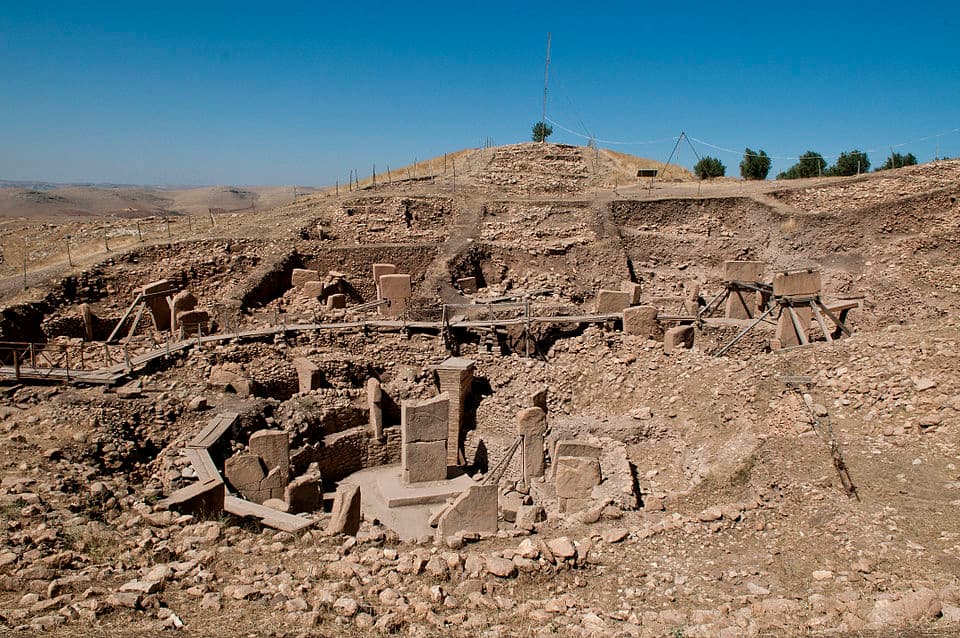
To understand Karahantepe, you need to understand where it sits — literally and historically.
Southeastern Turkey, the region known as Şanlıurfa, is one of the most archaeologically dense places on Earth. This is the Fertile Crescent, the land between the Tigris and Euphrates rivers where — as the old story goes — civilization emerged. Somewhere in this region, humans first domesticated wheat, first kept goats, first stopped following herds and started planting fields. The Neolithic Revolution, the shift from hunting and gathering to farming, is supposed to have begun somewhere around here, around 10,000-8,000 BCE.
For decades, the dominant story was comfortingly logical: agriculture came first, then surplus food, then population growth, then social complexity, then religion, then monumental architecture. You need stable settlements before you can build temples. You need organized labor before you can quarry and shape stone. You need writing or at least accounting before you can coordinate large-scale construction projects.
Then, in 1994, a German archaeologist named Klaus Schmidt started excavating a hill called Göbekli Tepe — 'Potbelly Hill' in Turkish — and the neat story fell apart.
Göbekli Tepe turned out to be the world's oldest known temple complex: massive circular enclosures with T-shaped limestone pillars up to six meters tall, carved with extraordinarily detailed animal reliefs — foxes, scorpions, vultures, aurochs, snakes, crocodiles — all assembled with remarkable precision by people who, the evidence strongly suggested, had not yet adopted agriculture. They were hunter-gatherers. They were doing this before farming.
This was revolutionary. It upended the comfortable sequence: if complex monumental architecture predated agriculture, then perhaps religion — or at least communal ritual — was not a product of settled civilization. Perhaps it was one of civilization's causes.
Göbekli Tepe became world-famous. It became a UNESCO World Heritage Site. It was called 'the world's first cathedral,' 'the birth of religion,' 'the zero point of history.' Books were written. Documentaries were made.
And then archaeologists started finding more hills nearby.
Taş Tepeler: Göbekli Tepe Was Just the Beginning
The Taş Tepeler project — 'Stone Hills' in Turkish — is one of the most ambitious archaeological undertakings of the twenty-first century. Launched by Turkey's Ministry of Culture and Tourism, it is simultaneously excavating more than twelve Neolithic sites spread across the Şanlıurfa region, all dating to roughly the same period: approximately 9,400 to 8,000 BCE.
Each site has its own character. Göbekli Tepe, the flagship, is dominated by animal imagery and monumental scale. Karahan Tepe — Karahantepe — is 35 kilometers to the east, nestled in the Tek Tek Mountains, and it is dominated by something else entirely: the human face.
Karahantepe was first identified in 1997, but serious excavation only ramped up in the 2010s and 2020s under the direction of Professor Necmi Karul of Istanbul University. What they found as they dug deeper into the limestone bedrock was not just another Göbekli Tepe — it was something different enough to change the picture completely.
The site covers a significant area and consists of structured rooms carved directly into the bedrock, many of them filled with statues, carved pillars, and symbolic objects. More than 250 T-shaped pillars have been found in situ. There are rooms with stone bowls set into the walls and channels to carry liquid — evidence of ritual activity involving fluids. There are chambers lined with carved human heads. There is a room containing eleven monumental phallic carvings, among the earliest known examples of phallic symbolism. And there is the structure that made headlines in 2025.
The Amphitheater Discovery
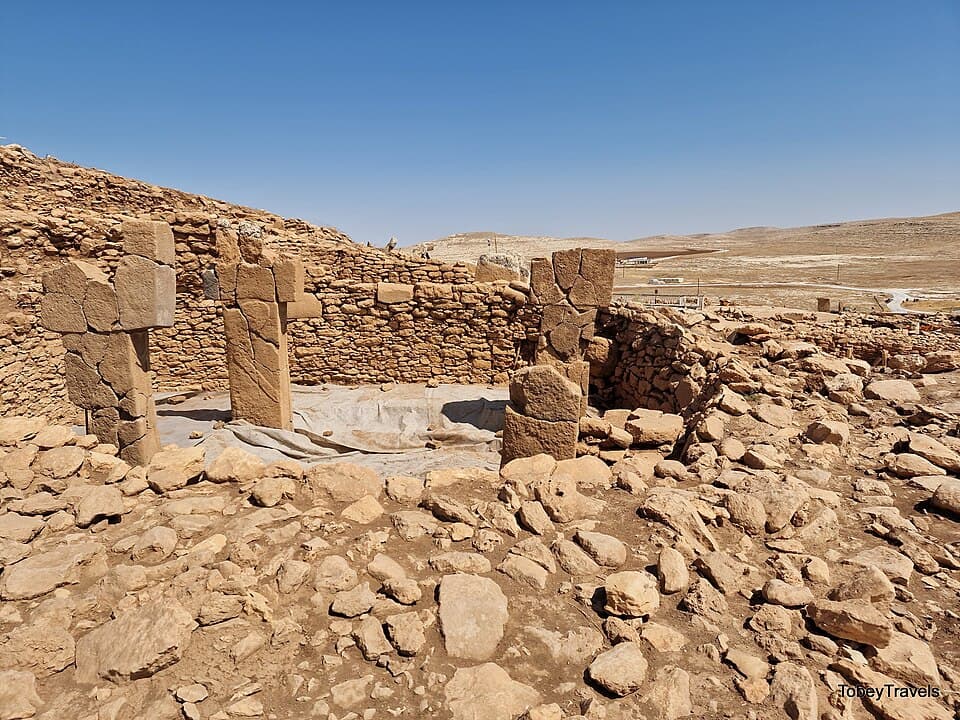
In late 2025, Professor Karul and his team announced the discovery of what they described as an 'amphitheater-like' structure at Karahantepe — and the description, unusual as it sounds for a Neolithic site, is apt.
The structure is roughly 17 meters in diameter — about the size of a modest tennis court. Its floor is carved directly into the limestone bedrock, and it was not built up from the ground but excavated downward, creating a sunken space. Around the interior perimeter, the team found three wide, tiered stone benches, each stepped higher than the one in front of it, arranged in a curved configuration that curves toward a central focal point.
At that focal point — the place where the three sets of benches all face — there is a socket in the floor, the remnant of a large sculpture that once stood there but has since been removed or destroyed. Around the walls, carved human heads emerge from the stone. On the ground level of the space, several seated human statues were found, positioned to face inward.
Karul's description of the structure is striking: 'The focal point contains a sculpture, but opposite it there are three very broad, multi-layered benches, almost like an odeum or amphitheater. The size and depth of these tiers suggest that groups of people may have sat here.'
An odeum, for context, was a small covered theater in ancient Greece and Rome, used for musical performances and small assemblies. The oldest Greek odeums date to around the 5th century BCE — roughly 8,500 years after Karahantepe was built.
This isn't merely a circular room with walls. The geometry is deliberate and directional: the benches face the center. Whatever happened in this space, people sat in organized tiers and watched — or participated in — something happening at the focal point. The architecture implies an audience. It implies a performance, a ceremony, a ritual, a gathering with a center of attention.
Karul has proposed that the amphitheater's function was primarily social rather than strictly religious — a space for strengthening communal bonds among a growing, increasingly complex population: 'If they were temples, their roles would have been more limited. Instead, it appears that their primary function was to bring people together. This is a design that continues in later eras as amphitheaters and odeums.'
The size and depth of these tiers suggest that groups of people may have sat here. This is a design that continues in later eras as amphitheaters and odeums.
— Professor Necmi Karul, excavation director at Karahantepe, Istanbul University
The Face in the Stone: A Revolution in Symbolism
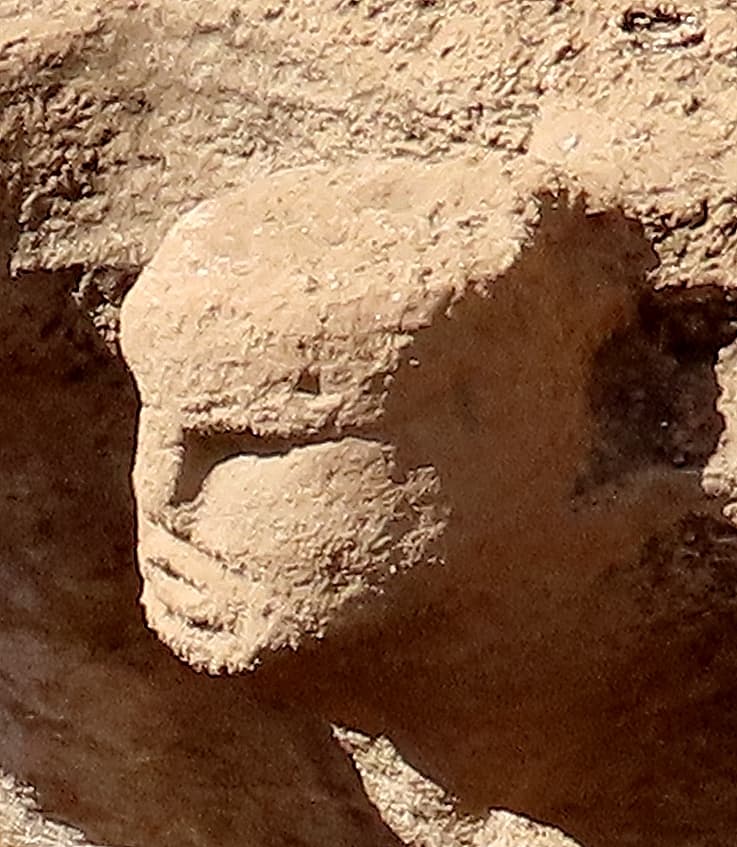
The amphitheater is the most dramatic recent discovery at Karahantepe, but it sits within a larger pattern that archaeologists have been tracking since excavations began in earnest: Karahantepe is obsessed with the human face in a way that Göbekli Tepe simply isn't.
Göbekli Tepe's T-shaped pillars are covered in animal carvings. Foxes, snakes, scorpions, wild boar, vultures, cranes, ducks, gazelle, aurochs — the animal world rendered in extraordinary detail. The few human images at Göbekli Tepe are more abstract, less central. The world at Göbekli Tepe looks out at nature, at predators and prey, at the wild animal kingdom that surrounds and threatens human life.
Karahantepe looks inward. The site holds one of the largest concentrations of human face depictions known from the Neolithic era anywhere in the world. Heads emerge from the walls of ritual chambers. Full human figures sit in carved alcoves. A remarkable carved pillar features a detailed human face — eyes, nose, lips — with unusual realism for a time period not known for portraiture. The 2025 season also produced what researchers describe as possibly the world's oldest three-dimensional narrative: a carved stone scene depicting a sequence of events involving human figures.
This shift in symbolism is significant. At Göbekli Tepe, the human presence is implied — the builders are there, but the imagery looks outward at a world defined by dangerous animals. At Karahantepe, the human is the subject. The face stares back at you from the wall. The seated figure watches from the corner. The assemblage places the human form at the center of its symbolic vocabulary.
Researchers interpret this as evidence of a profound shift in how early humans understood themselves. Göbekli Tepe's animal world may reflect a hunter-gatherer cosmology organized around the hunt, around the dangerous and sacred relationship between human and animal. Karahantepe's human-centered imagery may reflect something newer: an emerging sense of identity, community, selfhood. The moment when the face looking back from the stone wall became the most important thing in the room.
In 2025, the Smithsonian Magazine covered a specific discovery at Karahantepe that encapsulated this shift: a stone pillar with a realistic human face carved into it, described as representing 'the dawn of human identity.' It is a face from 11,000 years ago, and it has the quality of a portrait — not a symbol, but a person.
Who Were These People?
Here is the detail that most unsettles the standard history of civilization: Karahantepe was built by hunter-gatherers.
Not farmers with surplus grain. Not settled villagers with time on their hands after the harvest. The people who carved these amphitheaters and ritual chambers and human faces into the limestone bedrock of the Tek Tek Mountains were people who still followed herds, still hunted gazelle and wild cattle, still gathered wild cereals rather than cultivating them. The faunal remains found at the site include aurochs, gazelle, birds, fish, and tortoise — a hunter-gatherer diet.
This is extraordinary. The old model said you needed agriculture before you could have monumental architecture. You needed stable settlements, surplus food, organized labor, social hierarchy. You needed civilization first, and then religion and temples and public spaces emerged from it.
Karahantepe — like Göbekli Tepe before it — says this is backwards. Or at least, incomplete. These sites suggest that the impulse to build was not a product of agricultural surplus. It may have been one of the forces that drove people toward agriculture in the first place. Build a temple complex that requires communal labor and regular returns to maintain it, and you create incentive to stay in one place, to cultivate food nearby, to develop more permanent settlements.
This theory — that religion and communal gathering spaces preceded and perhaps caused agriculture rather than following from it — is one of the most hotly debated ideas in contemporary archaeology. Göbekli Tepe is its central exhibit. Karahantepe is now exhibit B.
The people of Karahantepe were in transition. They hunted wild animals but also processed wild cereals (evidence of wheat and barley processing has been found at nearby sites in the region). They hadn't yet fully committed to farming, but they were already building permanent, elaborate, architecturally sophisticated gathering places. They were, in a sense, caught in the act of becoming something new.
The Ritual Architecture of Liquid
One of the more evocative details from Karahantepe's excavations is a recurring architectural feature: stone bowls set into the walls of ritual chambers, connected to carved channels that would carry liquid across the floor.
In one rectangular communal building excavated higher on the Karahantepe complex, four pillars rise from the bedrock floor and benches line the walls. On the north wall, a stone bowl is set into the stonework, and a carved channel runs from it across the floor. Karul has stated directly: 'These construction details show us this building was used for some ritual reason, and this liquid was a part of this ritual.'
What liquid? Water, almost certainly, but possibly also fermented drinks — early evidence of beer or other fermented beverages has been found at Neolithic sites across the region. The Neolithic was, among other things, the era when humans began brewing. The social function of communal drinking — its role in bonding, ceremony, inebriation as a ritual state — may be as old as any other form of organized religion.
The liquid channels at Karahantepe suggest ritual practices that were participatory and sensory, not merely observational. Whatever ceremonies took place in these rooms involved people consuming or engaging with a liquid substance as part of the rite. The amphitheater had an audience; the ritual chambers had participants.
There is something deeply human about this detail — something that connects these people across eleven millennia to every subsequent culture that has poured libations to the dead, shared wine at communion, passed the kava bowl in a Fijian ceremony, or opened a bottle at a gathering of friends. The act of sharing a liquid substance in a ritually charged space is apparently very, very old.
The Burial of Karahantepe
Around 8,000 BCE, roughly 1,400 years after its construction began, Karahantepe was deliberately buried.
This is one of the stranger facts about the site, and it mirrors something that happened at Göbekli Tepe as well. At some point, the people who used these sites systematically filled them in — covering the pillars, filling the chambers with rubble and soil, burying the structures under the hillside as if interring them. Then they left.
Why? Nobody knows. But the deliberateness of the burial is evident from the archaeological record — this wasn't gradual abandonment and silting. This was intentional. Someone organized significant labor to bury something that someone else had organized significant labor to build.
One interpretation is that these sites had finite lives within a specific cosmological framework — that they were built for a purpose, used for their purpose, and then ritually retired when that purpose was complete or when the community moved on. The burial was not an erasure but a kind of preservation: by covering the structures, the builders protected them from the elements, incidentally ensuring that archaeologists would find them intact seven thousand years later.
Another interpretation, more speculative, is that the burial was a response to a fundamental change in belief systems — that by 8,000 BCE, the worldview that had generated these sites was being replaced by something new, and the burial was a cultural severance from the old ways.
Whatever the reason, the burial is one of the things that makes Karahantepe and Göbekli Tepe so extraordinary to excavate. They are time capsules, sealed by the hands of the people who built them, preserving the material culture of a moment in human history that is so early it barely has a name.
What This Rewrites About Human History
Let's be precise about the implications of Karahantepe, because it's easy to let the wonder blur into vagueness.
First: monumental communal architecture is older than we thought, and it appears to be independent of agriculture. The standard sequence — farm, settle, organize, build — is at minimum incomplete. Hunter-gatherers built amphitheaters. They carved theaters into bedrock. They created spaces for communal gathering with deliberate, sophisticated geometry. They did this without metal tools, without written language, without the wheel, without any of the technologies we associate with 'civilization.' They did it with stone and labor and a shared purpose we can only partly infer.
Second: the human impulse to gather in formal, designed spaces and conduct collective rituals may be one of the oldest and most universal features of our species. Before farming, before cities, before writing, humans were already building places where groups of people could sit in organized tiers and direct their attention to a common focal point. The amphitheater, as an architectural concept, is apparently native to the deep human past — not an invention of sophisticated culture, but one of its foundations.
Third: the symbolic life of early humans was richer and more varied than we knew. The contrast between Göbekli Tepe's animal world and Karahantepe's human-centered imagery suggests that different communities in the same region, at the same time, were developing genuinely different symbolic frameworks. This is not a monolithic Neolithic consciousness — it is already diverse, already contested, already producing different answers to the question of what matters and what deserves to be carved in stone.
Fourth: there is still so much we don't know. The Taş Tepeler project is excavating twelve sites simultaneously, and they are all still being uncovered. Karahantepe itself is far from fully excavated. The amphitheater was discovered in 2025; what lies beneath it, or around it, or in the chambers not yet opened, is unknown. Every season produces something that changes the interpretation of the season before.
We are, in a very literal sense, still discovering who we were. The oldest assembly room in the world is being uncovered right now, by teams of archaeologists working in the Şanlıurfa heat, brushing soil from limestone that hasn't seen daylight in nine thousand years.
Somewhere under that hill, more faces are waiting to look back at us.