The City Under the Ice
In 1959, the U.S. Army carved a nuclear-powered town out of the Greenland ice sheet — and quietly used it as cover for a plan to hide 600 missiles from the Soviets. Sixty-five years later, the abandoned base is still down there, slowly being crushed in slow motion, and a melting climate is forcing us to reckon with what it left behind.
Key Facts
- **Built:** 1959–1960, by the U.S. Army Corps of Engineers, 150 miles inland from Thule Air Base.
- **Size:** 21 trenches totaling about **3 km (1.9 miles)** of tunnels, sitting at 6,600 ft elevation on the Greenland ice sheet.
- **Population:** ~200 personnel at peak; no women — the Women's Army Corps wasn't merged into regular units until 1978.
- **Power:** The PM-2A — the world's first portable nuclear reactor. Ran for 33 months on 44 lbs of uranium.
- **Real mission:** Project Iceworm — a proposed 4,000-km tunnel network housing **600 nuclear missiles** aimed at the USSR. Cancelled in 1966.
- **Left behind:** 200,000 liters of diesel, 24 million liters of sewage, PCBs, and 1.2 billion becquerels of radiological waste — buried at ~36 m (118 ft) depth as of 2016.
- **Bonus discovery:** The deepest ice cores ever drilled at the time (1966) launched modern climate science. Sediment from underneath them, lost in a freezer for decades, holds plant fossils proving Greenland was nearly ice-free as recently as 400,000 years ago.
A church, a theater, a barber shop — under a mile of ice
One way to begin this story is with the brochure.
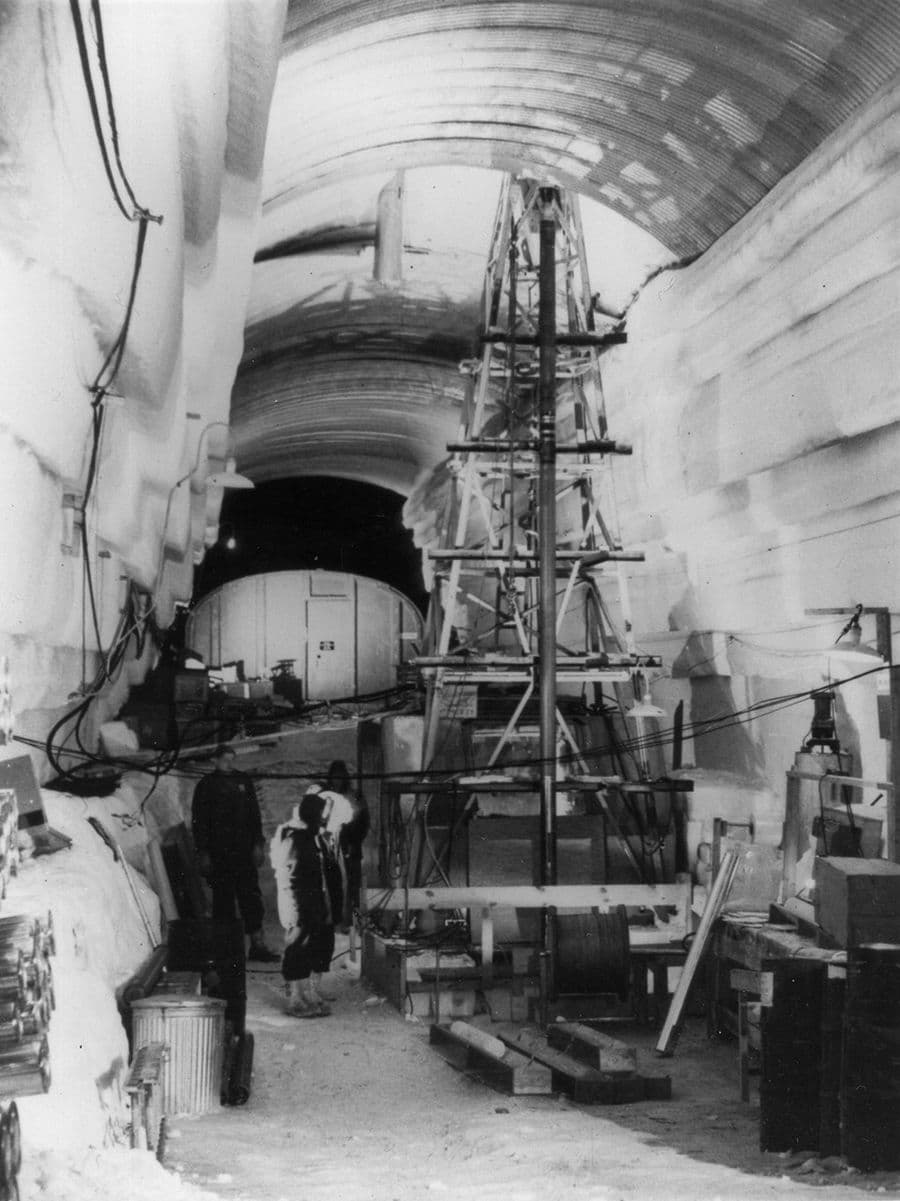
In 1960, the U.S. Army handed reporters a glossy account of a place called Camp Century — a 'scientific outpost,' 800 miles from the North Pole, carved into the Greenland ice sheet. The brochure described a snug little town inside the snow: 21 trenches roofed with arched steel, prefabricated huts inside the trenches, a hospital, a barber shop, a chapel, even a theater. It housed about 200 men. It was lit, heated, and fed by the world's first portable nuclear reactor. The Saturday Evening Post ran a feature on it. Walter Cronkite himself flew in for a CBS broadcast in 1961, marveling at the 'city under the ice.'
What none of those reporters were told — what wasn't fully declassified until 1996, more than three decades later — was that Camp Century was a cover. The actual purpose of all that engineering was Project Iceworm: a plan to bury 600 nuclear missiles under the Greenland ice in a 2,500-mile network of tunnels, on rails, shuffled around like cups on a sleight-of-hand table so the Soviets could never know where any one of them was. The 'Iceman,' they called the proposed missile — a stubby, two-stage version of the Air Force's Minuteman, sized to fit beneath the snow.
The plan was insane in the precise way that mid-century engineering tended toward insanity: it assumed the ice was solid and the future was a known quantity, both of which turned out to be wrong. By the mid-1960s, the tunnels were buckling under their own weight. By 1967, the camp was abandoned to the snow with all its waste left behind on the assumption it would be entombed forever. And right now, in 2026, climate scientists are using that abandoned base as a benchmark for one of the more uncomfortable questions in environmental science: what happens when the ice you trusted to bury your secrets stops being trustworthy?
Why an ice base, and why Greenland?
To understand why anyone thought this was a good idea, you have to remember what 1958 looked like. The Soviets had launched Sputnik the previous October. The U.S. was deep in the era of 'missile gap' panic. The Air Force, the Navy, and the Army were locked in a brutal interservice fight over who would deliver America's strategic deterrent. The Air Force had Minuteman ICBMs and B-52s; the Navy had Polaris submarines. The Army had nothing comparable, and was watching its share of the nuclear pie shrink.
Enter the Greenland ice sheet. It is, by area, the second-largest body of ice on Earth. It is closer to Moscow than any U.S. mainland base. It belonged, technically, to Denmark — a NATO ally — but the Danish government had a public, peace-loving prohibition on stationing nuclear weapons on Danish soil. Conveniently for the Pentagon, the Danish prime minister at the time, H.C. Hansen, had quietly written a secret note to the U.S. ambassador in 1957 saying he didn't actually want to know whether the U.S. was bringing nuclear weapons to Greenland. (That note became one of the best-kept secrets in Danish history. It surfaced in 1995, in the wake of an inquiry into a 1968 incident in which a B-52 carrying four hydrogen bombs crashed near Thule.)
So Greenland looked like the perfect answer to an Army strategist's prayer: ally-controlled, missile-friendly geography, with a head of state who could be politely deceived by his own choice. All the Army had to do was prove that you could actually live and work and operate machinery inside an ice sheet — and then, once that was demonstrated, scale up to 600 launchers under a parking lot the size of three Denmarks. Camp Century would be the proof of concept. Iceworm would be the result.
'Strategic Value of the Greenland Icecap.' That was the title of the 1960 Army report, declassified in 1997, that laid out Project Iceworm. The plan called for tunnels covering 52,000 square miles — three times the size of Denmark itself.
Cutting a town out of the snow
Construction started in June 1959. The Corps of Engineers used Swiss-built rotary snow plows — essentially giant industrial snow blowers — to gouge out parallel trenches in the surface of the ice sheet. The technique they used has a name: 'cut and cover.' You dig the trench, you put a curved steel arch over the top, and then you let snow drift over the arch until the whole thing is buried. By the time you're done, what was a 26-foot-wide trench has become, from the surface, just a slight depression and a stovepipe sticking out of the snow.
Inside each trench, the engineers erected prefabricated wooden buildings, leaving an air gap between the buildings and the ice walls so that residual heat wouldn't melt the trench shut. The longest trench, 'Main Street,' ran 1,100 feet end to end. There were sleeping quarters, a mess hall, a laundry, a library, a dispensary, a chapel, a barber, and a movie theater. There was a research lab. There was a hobby shop. The whole thing felt, by the accounts of soldiers stationed there, like a strange wooden submarine that didn't move.
Water came from 'Rod wells' — heated probes lowered into the firn (compressed old snow) until they melted a teardrop-shaped cavern. The water was checked, somewhat improbably, for plague. Sewage went into a sump 150 feet from the nearest building. The sump was originally unvented, which is the kind of design decision that becomes a story; within a year, the smell in the nearest sleeping trenches was, in the Army's own words, 'almost unbearable.' Subsequent venting helped. It did not solve the problem.
The reactor that fit on a cargo plane
The most extraordinary thing inside Camp Century — more extraordinary than the chapel, more extraordinary than the theater — was the PM-2A. It was a pressurized light-water nuclear reactor, designed by Alco (the locomotive company) for the U.S. Army Nuclear Power Program, and it was the world's first portable nuclear reactor. The Army called it 'portable' the way a couch is portable: at 330 tons, it was technically movable, in pieces, each piece sized to fit through the cargo door of a C-130 Hercules.
It arrived at Thule Air Base in July 1960, was dragged 138 miles across the ice sheet, and was reassembled at Camp Century inside its own dedicated trench. By October it was running. The Army, which had a flair for marketing, boasted that this single reactor needed just 44 pounds of uranium to do the work of more than a million gallons of diesel fuel — which, in a place where every gallon of diesel had to be hauled across an ice sheet by tractor train, was a meaningful claim.
The PM-2A produced about 1.5 megawatts of electricity for 33 months. Over its operating life it generated 11.2 million kilowatt-hours, powered the lights and the heating system and the snow-melt water supply, and proved — at least on paper — that you could install a nuclear reactor in a hole in a glacier and have it work. It is one of the more unsung achievements of mid-century engineering, in part because the Army nuclear power program was eventually shut down, and in part because this particular reactor's home was abandoned a few years after it was switched off.
The reactor was removed in 1964. It produced, over its lifetime, about 1.2 billion becquerels worth of radiological waste — primarily contaminated coolant water — which was, in keeping with practice at the time, dumped into a sump in the ice and left behind.
The ice was lying to them
Here is the thing about ice sheets. From the surface, in the right kind of light, the Greenland ice sheet looks like polished granite. It is white, it is featureless, it is cold, and your boot does not sink into it. It feels, intuitively, like something you can build on.
It is, in fact, more like a viscous fluid. Ice and compressed snow are viscoelastic materials: under enough pressure and over enough time, they deform. They flow. Greenland's ice spreads outward from its center at rates that would be invisible if you were standing still and crushing if you were trying to keep a tunnel open. The rate of motion at Camp Century is about three-and-a-half meters per year, and the trenches were getting squeezed both vertically and horizontally — narrowing, sagging, bulging.
By 1962, just three years after construction, the trenches had compressed close to their design margins. The reactor room ceiling had to be jacked up five feet that year to keep it from caving in on the reactor. Snow trimming — workers physically scraping ice off the trench walls to keep them from closing — became a constant chore. In 1964 the reactor was pulled out. In 1965 the Army officially admitted that subsurface ice basing was not feasible at the scale Iceworm required: a 2,500-mile tunnel network would be a maintenance nightmare. The plan was killed. The base was downgraded to a summer-only station. By 1967 it was abandoned entirely.
What's worth pausing on, here, is what the ice's behavior actually was. The Pentagon planners who dreamed up Iceworm had assumed the ice was passive infrastructure — a giant building site that just happened to be cold. The ice, it turned out, had its own physics, on its own timescales, and was unimpressed. Within a few years it had started to digest the entire camp, slowly, the way a glacier digests a fallen tree.
Although the Greenland icecap appears, on its surface, to be hard and immobile, snow and ice are viscoelastic materials, which slowly deform over time. Despite its seeming stability, the icecap is in constant, slow movement, spreading outward from the center.
— U.S. Army post-mortem on Project Iceworm, 1965
The accidental gift: a tube of frozen time
One of the small surprises of Camp Century is that, hidden inside a Cold War boondoggle, was probably the single most important early experiment in modern climate science.
In addition to all the secret missile work, Camp Century was a real research base, and one of the projects underway there was an attempt to drill the first deep ice core — to bring up a column of ice from a mile down, layer by annual layer, like reading the rings of a tree. Two scientists, Chester Langway and B. Lyle Hansen, ran the operation. They drilled for five years. In the summer of 1966, they finally hit bedrock at a depth of about 1,387 meters — about 1.4 km, or just under nine-tenths of a mile.
And then, almost as an afterthought, they kept going. Their drill brought up an extra 3.4 meters of subglacial sediment — actual mud and rock from under the ice sheet, the kind of material no one had ever sampled before. They labeled the tubes, shipped them to a lab, and the ice itself went on to revolutionize science.
What the Langway core showed, when Danish glaciologist Willi Dansgaard later analyzed the oxygen isotopes of the water, was something that genuinely changed how we understand the climate. The ice preserved a record of ancient atmospheric temperatures, year by year, going back more than 100,000 years. And it showed that the Earth's climate did not change slowly and smoothly. It lurched. There were abrupt warming events — now called Dansgaard-Oeschger events in honor of Dansgaard and his Swiss colleague Hans Oeschger — in which the climate could shift by 10° C in just a few decades. The discovery rewrote the entire field. Modern climate models, the IPCC reports, the entire conversation about tipping points: it all traces back, in part, to a Cold War boondoggle in northwest Greenland.
A frozen time bomb — or maybe not
For most of the late twentieth century, Camp Century was a curiosity — a Cold War footnote, a piece of trivia about ice cores. It became newsworthy again, abruptly, in August 2016, when the geophysicist William Colgan and his colleagues published a paper in Geophysical Research Letters with a flat, alarming title: 'The abandoned ice sheet base at Camp Century, Greenland, in a warming climate.'
The argument was straightforward. The Army had abandoned the base in 1967 on the assumption that the ice would only ever accumulate, burying the waste forever. That assumption was made before climate science existed in any modern sense. Colgan and his team ran climate models forward. They estimated that the surface mass balance at Camp Century — that is, the amount of snow falling versus the amount of ice melting — could plausibly flip from net accumulation to net ablation within 75 years. Once that flip happened, it would take another 44 to 88 years of melting to expose the buried debris. The window they identified for the camp's contents to begin reaching the surface was roughly the year 2090, with full exposure possibly between 2135 and 2179.
And there was a lot of waste. The 2016 inventory: 9,200 tons of physical infrastructure (buildings, vehicles, the steel arches of the trenches); 200,000 liters of diesel fuel; 24 million liters of biological waste (sewage and gray water, in unlined sumps); a non-trivial quantity of PCBs (polychlorinated biphenyls, the persistent industrial pollutants used in transformer oils and paints, banned since the late 1970s); and 1.2 billion becquerels of radiological waste, primarily reactor coolant.
The PCBs, Colgan's team wrote, were probably the biggest concern. They are persistent, they bioaccumulate up food chains, and if they reached the open ocean — Camp Century is roughly 250 km from the coast — they could start showing up in fish, in seals, and in the bodies of the people who eat seals. Greenland's Inuit population already has some of the highest PCB body burdens on Earth, in part from atmospheric transport of pollutants from elsewhere.
The 2016 paper landed at the intersection of climate alarm and Cold War embarrassment, and it kicked off an immediate political fight. Greenland's premier called for a cleanup. Denmark looked, predictably, at the United States. The United States noted that, technically, the waste was on Danish soil and the Danes had agreed to the camp's construction. Each side, in private, made the argument that the other side had inherited the responsibility. As of this writing, no government has formally accepted ownership of the waste at Camp Century.
And then, in 2021, an interesting thing happened. A follow-up study by Colgan's own team, now using climate model data calibrated to actual observations from a monitoring station they'd installed at the site, came to a quieter, less alarmed conclusion: meltwater was not, in fact, reaching the buried debris. In the years they had been measuring, surface meltwater had never penetrated more than 1.1 meters into the firn. Snowfall was still exceeding melt. 'Since the amount of annual snow will continue to exceed the annual melting,' Colgan said, 'the mapped debris field will continue to be buried deeper in the Greenland ice sheet. In other words: there is no risk that the debris will come to the surface due to melting before 2100.'
It is rare in science journalism to see the original scary headline get walked back this cleanly by the same researcher who wrote it. The 2021 result didn't say Camp Century was safe forever — only that the most aggressive timelines from 2016 had been overstated, and that the immediate emergency had eased. The 2090–2179 window for exposure has, for now, slipped back. But the buried inventory is unchanged. The PCBs do not biodegrade. The diesel does not evaporate. The ice will eventually thin. The bill is deferred, not paid.
Found again, by accident
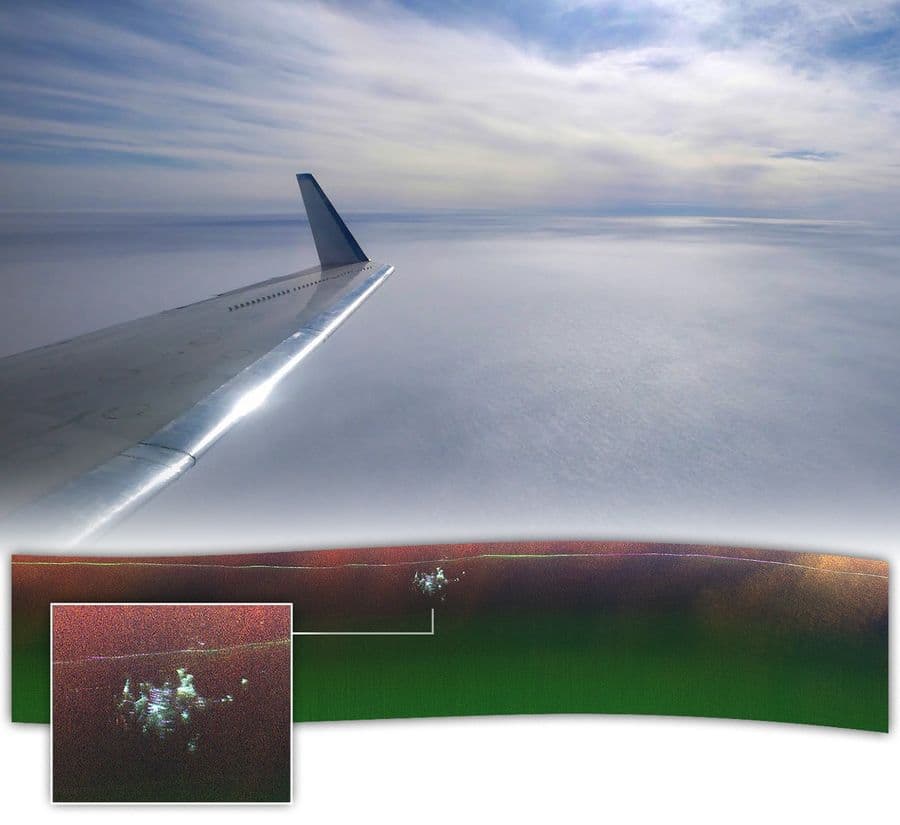
In April 2024, a NASA scientist named Chad Greene was flying a Gulfstream III with a synthetic-aperture radar instrument bolted to its belly, somewhere over northwest Greenland. He was working on a calibration problem — trying to validate the UAVSAR system's ability to image the deep internal layers of the ice sheet, the kind of measurement that helps science predict future sea level rise. He was not looking for Camp Century.
'We were looking for the bed of the ice and out pops Camp Century,' Greene's colleague Alex Gardner said afterwards, in the NASA Earth Observatory writeup. 'We didn't know what it was at first.'
What the radar saw — what the new image showed when they processed it — was a set of unmistakable parallel lines, buried about 30 meters below the snow, in the precise pattern of the camp's tunnels. Not a blip; not a smear. Discrete, geometric, made-by-humans lines. The historical site map of Camp Century overlaid almost exactly. Sixty-five years after the trenches were dug, eighty meters of new snow on top of them, and they are still resolvable from a plane.
NASA called the image, with characteristic understatement, 'a novel curiosity acquired by chance.' It is also one of the strangest pieces of remote sensing imagery in recent memory: a 1959 Cold War nightmare, glimpsed in 2024 by a cryospheric scientist trying to do something else, lit up by the same instruments we use to model what the climate will do next.
What it leaves behind
The thing about Camp Century that keeps pulling you back to it, the longer you sit with it, is that it is not really one story. It is at least four stories, layered like the firn itself, each one nested inside the next.
The top layer is the brochure: a delightful, vaguely ridiculous Cold War feat — the city under the ice, the chapel and the barber, the reactor that fit on a plane, the can-do American engineering of 1960. Walter Cronkite came. Boys' Life ran a feature.
Below that is the lie: the entire visible facility was a stage set for a missile program that was never disclosed, on land controlled by an ally that was deliberately not told the truth, in a strategic competition that justified, in the planners' minds, lying to a friendly head of state. That layer was kept frozen for thirty-six years and then quietly thawed by a 1995 Danish parliamentary inquiry.
Below that is the science: the most important early ice cores in the field, drawn up out of an Army sideshow, showing for the first time how violently the climate could swing, and producing — eventually, after a decades-long detour through a forgotten freezer — a tube of mud holding leaves from a Greenland with no ice.
And below all of that, still, are the drums. The diesel. The PCBs. The reactor coolant. Sitting in their slow ice grave at -24° C, mostly stable for now, while the climate they were buried in slowly turns into a different climate.
It is hard not to read Camp Century as a parable. The men who dug it believed they were operating on a fixed substrate — an ice sheet that would behave the same way forever, that would bury what they put in it, that would reward bold, large-scale plans with bold, large-scale results. Almost every part of that turned out to be wrong. The ice was not fixed; it deformed. The waste was not buried; it was, eventually, at risk of being unburied. The cover story was not a cover story; it became, decades later, the only story still being told. And the science they did almost incidentally — the ice cores nobody on the missile side cared about — turned out to be the only durable thing the camp produced.
If you ever find yourself flying north out of Pituffik, the modern name for what used to be Thule Air Base, look out the window. About 150 miles in, somewhere under a barely-visible dimple in the snow, are the remains of a city, and a chapel, and a reactor pad, and a sewage sump. They are very slowly being squeezed by ice. They are, just as slowly, being shifted toward the coast. They will eventually meet the sea. The question is mostly when, and what they will tell us about ourselves on the way.